Business websites, phone numbers, staff roles, locations, and contact routes change. A list is therefore a dated research snapshot, not permanent truth. A freshness policy records when and where a field was observed, defines which records deserve rechecking, and prevents teams from calling all old data equally trustworthy.
VISUAL LESSON
What you will learn
- 01Define field-level freshness metadata.
- 02Create risk-based recheck tiers.
- 03Document how changed and missing fields are handled.
ILLUSTRATIVE WORKED EXAMPLE
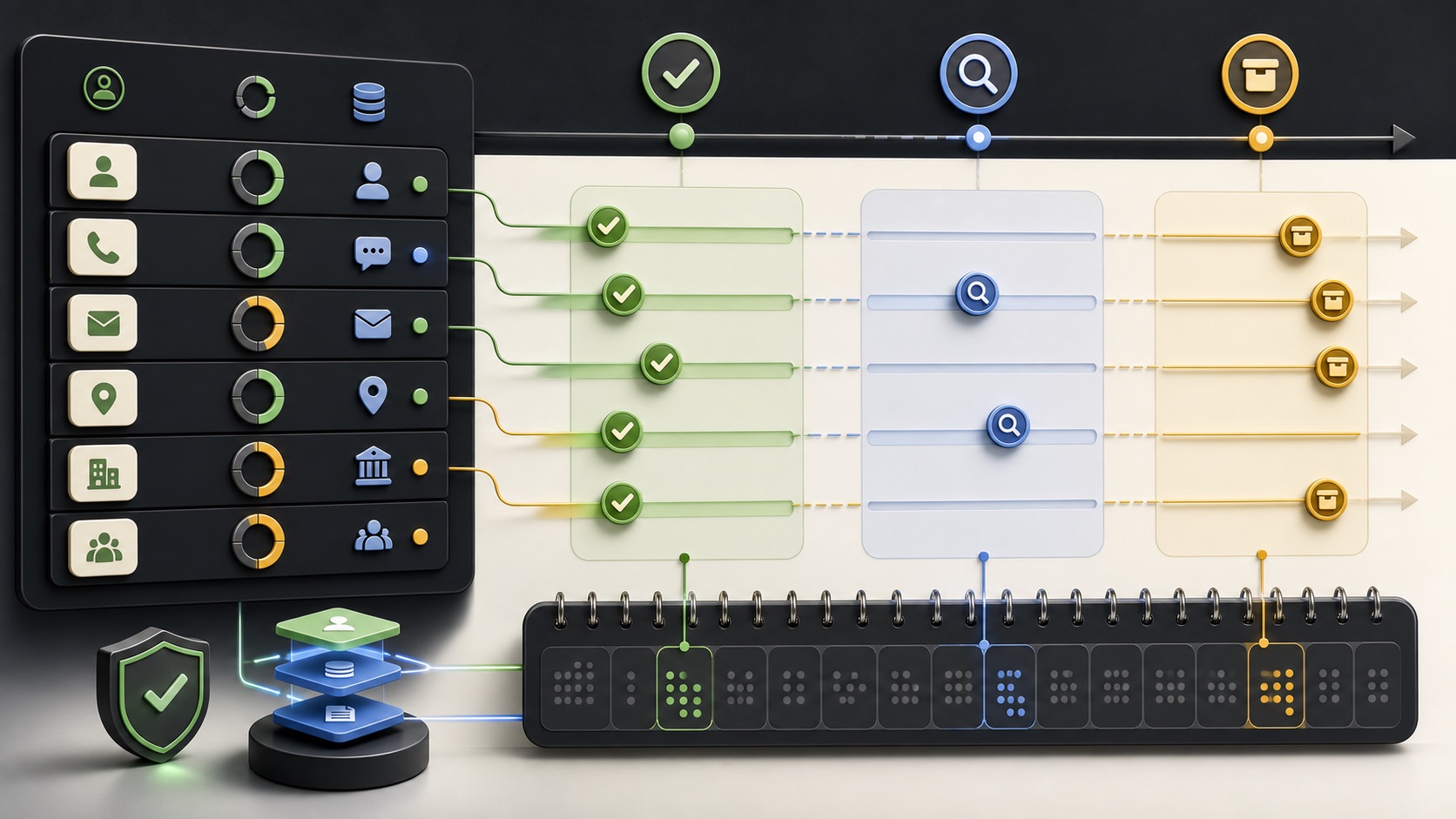
Recheck priority combines age, risk, and importance
PRACTICAL INTERFACE MAP
Attach freshness to the field and workflow
For each important field, preserve the public source URL, researched-on date, and what was actually visible.
Combine campaign start date, record value, field volatility, last verification, and consequence of error.
Mark verified, changed, removed, conflicting, or unavailable without silently overwriting the prior evidence.
STEP-BY-STEP LESSON
Dated evidence → risk tier → documented recheck
THE LEAD ATLAS METHOD
Lead Atlas Data is a done-for-you contact research service that can build current campaign-specific lists for requested markets, business categories, and locations.See how custom list research works ↗Define freshness honestly
Freshness means a field was observed or verified from a named source on a named date. It does not guarantee that the business will answer, that a role is still occupied, or that the information remains unchanged tomorrow.
Write separate definitions for found, verified, inferred, conflicting, and unavailable. Do not convert a missing public field into a negative assertion.
Store provenance at the right level
Company name, address, phone, email, contact form, and role can come from different pages and change on different schedules. Store source and observed date per field when those distinctions matter.
Preserve the raw value and evidence URL beside the normalized working value. A later reviewer should be able to understand what changed without guessing.
Build recheck tiers
Recheck high-value, role-specific, sensitive, or high-consequence records near the moment of use. Schedule active campaign records by a stated interval and sample lower-priority archives before reuse.
Adjust priority when a domain fails, a location closes, a record conflicts with another source, or outreach produces a clear correction. Age alone is not the only risk signal.
Resolve changes without erasure
When a field changes, record the new value, source, date, prior value, and status. When it disappears, mark not found on recheck rather than immediately declaring it invalid everywhere.
Use a conflict queue for sources that disagree. Prefer direct, current, authoritative business sources for operational details, and state uncertainty when it remains.
Run a pre-campaign audit
Select a risk-weighted sample, verify critical fields, calculate the share unchanged, changed, unavailable, and conflicting, and decide whether the whole segment needs a deeper refresh. Label the calculation as internal evidence.
Deliverable: freshness glossary, field-level provenance schema, tier rules, conflict workflow, dated audit sample, refresh decision, and customer-facing language that avoids permanent-accuracy promises.
Turn this lesson into a research brief.
Apply “Contact Data Freshness: Set Researched-On Dates and Recheck Rules” to one campaign before requesting or using a list.
- 01Market boundary
Name the locations and business categories this decision applies to.
- 02Fit evidence
Write the public signals that would make a business relevant enough to review.
- 03Exclusions
List the business types, markets, and records that should not enter the campaign.
- 04Outreach use
State who will review the list, personalize the message, and record outcomes.
THE TAKEAWAY
Store provenance and researched-on dates at the field level when practical, then recheck according to campaign risk and record importance rather than promising that data never changes.OFFICIAL REFERENCES