A business-contact list is more useful when the recipient can understand where a value came from and how recently it was reviewed. The source-evidence map connects a business identity to its official domain, public contact page, location page, footer, or other acceptable source. It does not guarantee that a person will answer or that public information will stay current; it makes the research decision auditable.
VISUAL LESSON
What you will learn
- 01Define an acceptable public-source hierarchy.
- 02Capture evidence at field level.
- 03Resolve conflicts and package a reviewable delivery.
ILLUSTRATIVE WORKED EXAMPLE
Audit an illustrative source-evidence cohort
PRACTICAL INTERFACE MAP
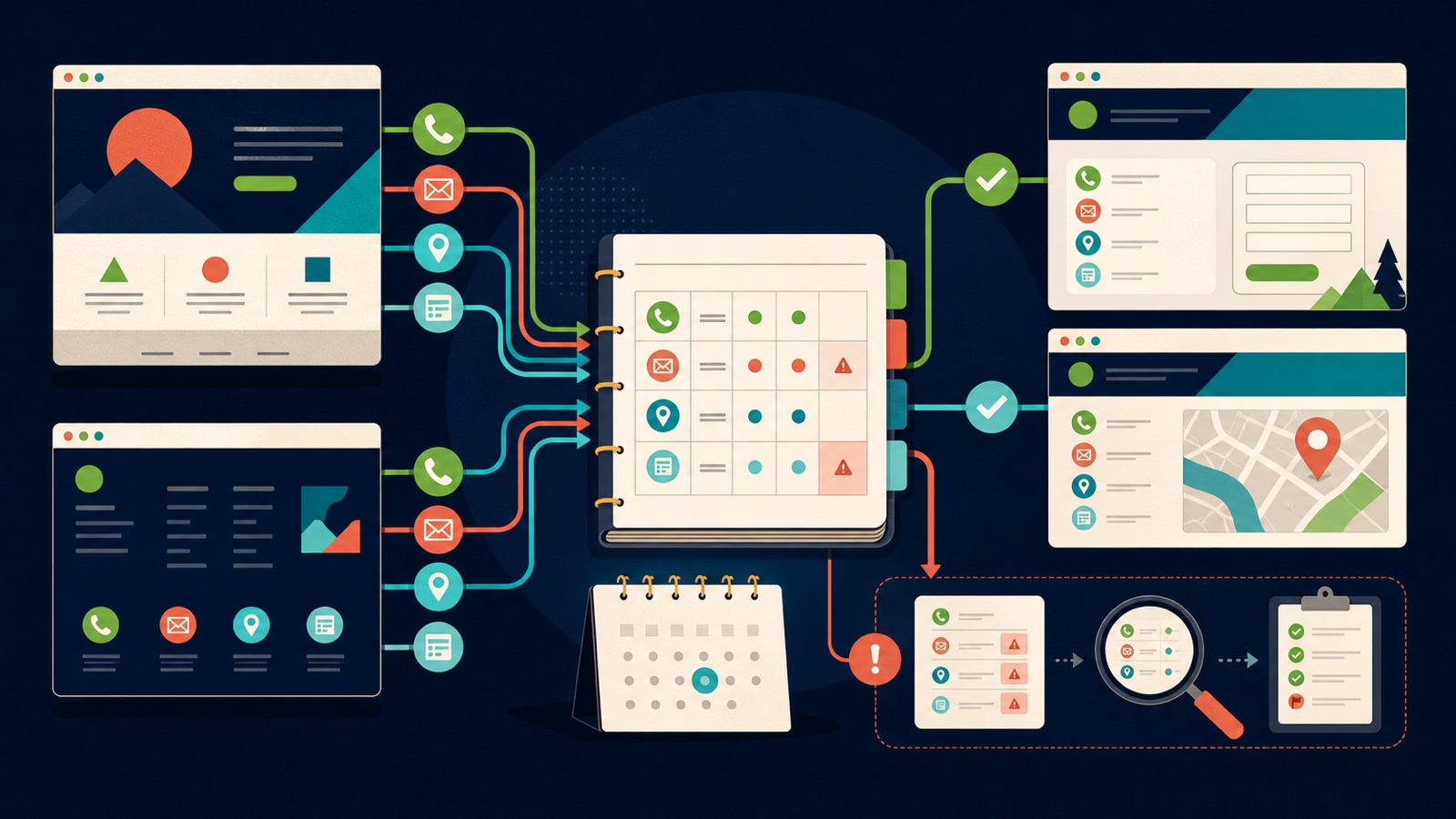
Capture evidence from identity to delivery
Match name, location, category, domain, phone, and other public signals before collecting contact values.
Record the public value, exact URL, page label or context, access date, and any caveat or conflict.
Keep verified, indirect, missing, stale, and conflicted records distinguishable in the final schema.
STEP-BY-STEP LESSON
Business identity → public source → field evidence → reviewable record
THE LEAD ATLAS METHOD
Lead Atlas Data can research a done-for-you business-contact list for the customer's exact campaign, market, locations, and business categories, with source context organized for practical review.See how custom list research works ↗Define the evidence policy
List acceptable public source types, prohibited sources, geography, business categories, fields, freshness target, identity requirements, confidence vocabulary, conflict rules, and delivery columns. Decide whether official domains, government registries, reputable directories, and social profiles have different uses and priority.
Keep availability separate from permission to contact. Public visibility does not remove the need to follow applicable law, platform rules, contractual limits, opt-outs, and the sender's own outreach policy.
Resolve the business before the contact
Match the requested entity using business name, category, address, location, domain, phone, brand relationships, and official location pages. Give every record a stable research key so same-name and multi-location businesses do not collapse into one row.
Record the search path and rejection reason for plausible but incorrect entities. If the official identity remains uncertain, flag it for review instead of collecting contact values from a convenient but unverified domain.
Capture evidence at field level
For each email, phone, contact form, website, address, or role, store the normalized value, exact source URL, page title or context, access date, source type, and whether the value was directly published or inferred. Avoid invented addresses or unsupported role assumptions.
Preserve raw and normalized values when practical. A phone in a footer, an email on a contact page, and a general form are different contact paths and should not be flattened into equivalent certainty.
Reconcile conflicts and freshness
When official pages disagree, compare location, page purpose, last visible update, structured data, redirects, and current site navigation. Prefer a documented business rule over whichever value appears first and retain the losing evidence when it explains the decision.
Classify outcomes such as confirmed, indirect, missing, stale, conflict, or unresolved. Run a second review on high-value records, same-name collisions, unusual domains, and fields with inconsistent geography.
Package an auditable delivery
Deliver business identifiers, normalized contact fields, source URLs, source context, access dates, confidence labels, exception reasons, and refresh guidance in a schema the customer can use. Deduplicate without erasing legitimate locations or distinct departments.
Deliverable: evidence policy, source hierarchy, entity key, official-domain map, field-level provenance schema, raw and normalized values, conflict queue, second-review log, freshness labels, deduplication report, exception summary, secure delivery manifest, and recommended refresh date.
Turn this lesson into a research brief.
Apply “B2B Contact Research: Build a Source-Evidence Map for Every Record” to one campaign before requesting or using a list.
- 01Market boundary
Name the locations and business categories this decision applies to.
- 02Fit evidence
Write the public signals that would make a business relevant enough to review.
- 03Exclusions
List the business types, markets, and records that should not enter the campaign.
- 04Outreach use
State who will review the list, personalize the message, and record outcomes.
THE TAKEAWAY
Capture the value, source URL, page context, access date, entity match, and conflict decision together so the delivered contact list remains explainable after research ends.OFFICIAL REFERENCES