Business data rarely has one perfect identifier. Names vary, phones are formatted differently, domains redirect, and several locations may share a brand. A defensible deduplication workflow normalizes fields, creates match tiers, and sends ambiguous pairs to review before records are merged or suppressed.
VISUAL LESSON
What you will learn
- 01Normalize common business identifiers.
- 02Create strong, probable, and review match tiers.
- 03Preserve branches and an auditable merge history.
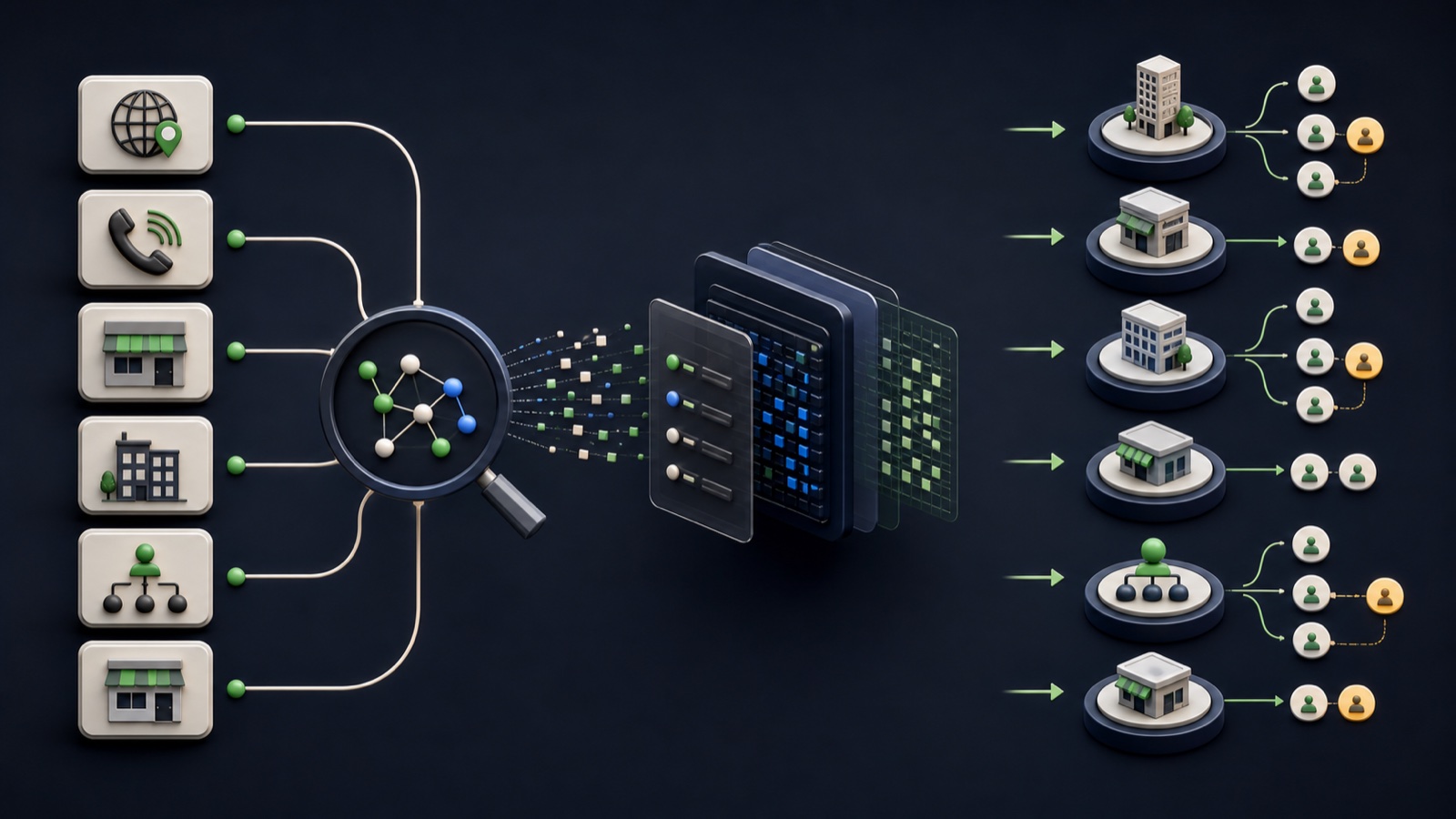
ILLUSTRATIVE WORKED EXAMPLE
Classify an illustrative duplicate-review queue
PRACTICAL INTERFACE MAP
Move records through a match queue
Preserve originals while standardizing domain, phone, business name, and address into helper columns.
Assign exact, probable, and possible tiers; exclude already resolved pairs from lower-confidence passes.
Choose keep separate, link as locations, merge, or suppress, and record the evidence and surviving values.
STEP-BY-STEP LESSON
Normalize → tier matches → review → preserve history
THE LEAD ATLAS METHOD
Lead Atlas Data can build a current custom business-contact list around specific categories, markets, and locations, giving the deduplication process a clearly defined campaign scope.See how custom list research works ↗Protect the source list
Keep an untouched copy with source, acquisition date, search scope, and record IDs. Create normalized helper columns rather than overwriting the public business name, phone, address, or URL that was researched.
Define what a duplicate means for the campaign. Two locations under one brand may be separate prospects, one account with several sites, or out of scope depending on the offer and ownership model.
Normalize stable identifiers
Convert websites to a comparable registered or chosen domain field after removing schemes, common prefixes, tracking parameters, and trailing paths as appropriate. Standardize phone country codes and digits while retaining the original display value.
Normalize whitespace, punctuation, common business suffixes, address abbreviations, and case in helper fields. Do not erase suite numbers, branch identifiers, or locality details that distinguish real locations.
Build match tiers
Start with high-confidence combinations such as exact normalized domain plus phone, or domain plus address. Use single-field matches as candidates rather than automatic merges when shared websites, call centers, or multi-location brands are possible.
For probable matches, combine normalized name, address, locality, website, and phone evidence. Assign each rule a tier and reason so reviewers know why a pair entered the queue.
Review branches and ambiguous pairs
Open the public website and compare location pages, contact details, legal identity where relevant, and the campaign's definition of a prospect. Mark same entity, separate location, related entity, unrelated, or unresolved.
Never choose the survivor only because it appears first. Prefer the record with clearer provenance and more recently verified fields, then preserve source-specific values and links to related locations.
Merge with an audit trail
Record the kept ID, retired ID, rule, evidence, reviewer, date, values retained, and whether the record was merged, linked, suppressed, or left separate. Re-run duplicate checks after imports and major enrichment work.
Deliverable: protected source file, normalized helper fields, tiered match rules, duplicate-candidate queue, branch review notes, survivor policy, merge log, and post-merge reconciliation counts.
Turn this lesson into a research brief.
Apply “Deduplicate a B2B Prospect List by Domain, Phone, and Address” to one campaign before requesting or using a list.
- 01Market boundary
Name the locations and business categories this decision applies to.
- 02Fit evidence
Write the public signals that would make a business relevant enough to review.
- 03Exclusions
List the business types, markets, and records that should not enter the campaign.
- 04Outreach use
State who will review the list, personalize the message, and record outcomes.
THE TAKEAWAY
Use exact domain and phone signals as strong evidence, combine weaker name-and-address signals carefully, and preserve every merge decision.OFFICIAL REFERENCES