Two businesses can share a name while operating in different cities or industries, and one company can publish several valid locations, domains, and phone numbers. A name-only deduplication rule can merge unrelated organizations or erase useful branches. Identity resolution is a documented comparison of public signals and an explicit decision to match, split, or review.
VISUAL LESSON
What you will learn
- 01Build a multi-signal entity key.
- 02Decide match, split, parent-child, or review.
- 03Deduplicate contacts without erasing real locations.
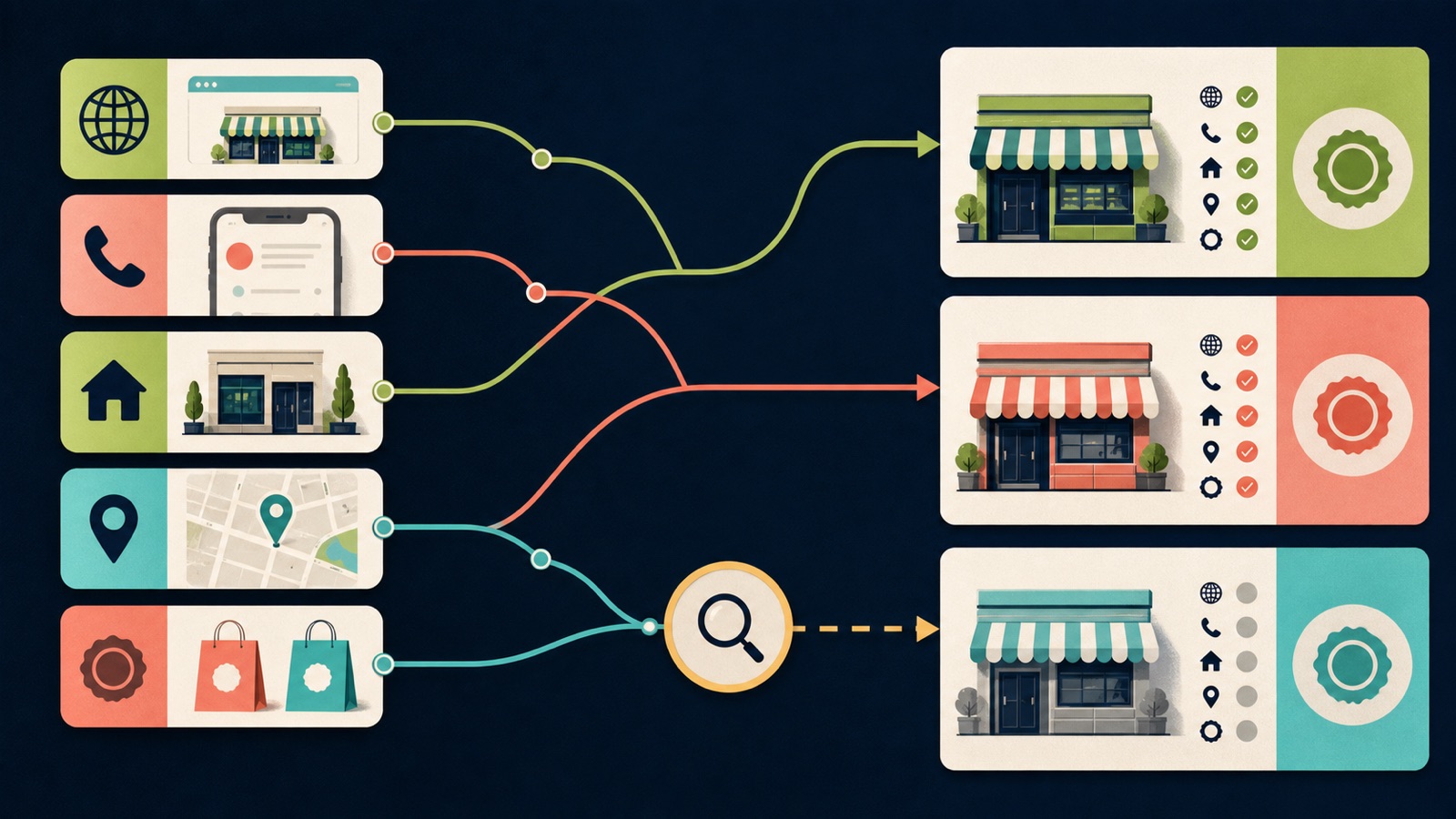
ILLUSTRATIVE WORKED EXAMPLE
Review an illustrative same-name collision
PRACTICAL INTERFACE MAP
Resolve a collision without a name-only merge
Preserve original name, category, city, region, query, and source before normalization changes the record.
Review official domain, address, phone, category, location page, legal or brand language, and parent-child relationships.
Assign a stable entity and location key, record decisive evidence, and leave unresolved cases out of automatic merges.
STEP-BY-STEP LESSON
Requested context → signal comparison → entity decision → protected deduplication
THE LEAD ATLAS METHOD
For category- and location-specific campaigns, Lead Atlas Data can build a custom business-contact list through done-for-you research that keeps same-name entities and multi-location records deliberately separated.See how custom list research works ↗Preserve the requested identity
Store the original business name, category, city, region, query, source, and requested location before normalizing punctuation, abbreviations, or legal suffixes. Assign a research-record key that does not assume two similar rows represent the same entity.
Define the unit the customer needs: legal organization, brand, physical location, franchise, department, or campaign account. A correct entity merge can still be wrong for a location-level outreach campaign.
Collect independent public signals
Compare official domains, location pages, street addresses, phones, categories, email domains, brand language, parent-company disclosures, registry identifiers where appropriate, and links between official properties. Record exact source URLs and access dates.
Treat shared names, shared directories, copied descriptions, and matching initials as weak signals. Treat a domain conflict, distant address, unrelated category, or explicit different owner as evidence requiring a split or review.
Use a decision rubric
Create match, split, parent-child, multi-location, franchise, and unresolved outcomes. A weighted score can order a review queue, but it should not conceal contradictory evidence or become an unsupported probability of identity.
State decisive signals and blocking contradictions. Require manual review when high-confidence fields disagree, a domain changed, a business moved, or one phone routes to several locations.
Resolve contacts at the right level
Attach a general corporate email to the organization only when its source supports that scope. Attach location phones and local forms to the location key. Preserve branch-specific and department-specific contact routes rather than promoting them to every record.
When deduplicating, normalize phone, email, domain, and address formats but retain raw values. Separate exact duplicate contact values from duplicate entities; a centralized phone can legitimately appear on several branch records.
Audit merges and unresolved cases
Sample accepted matches and splits, prioritize high-value records, and inspect changes that collapse several locations. Keep a reversible crosswalk from source rows to final entity and location IDs, with decision date and reviewer.
Deliverable: identity-unit definition, original request fields, normalization rules, multi-signal rubric, source map, collision queue, match/split/relationship decisions, entity and location IDs, contact-scope rules, duplicate crosswalk, manual-review log, unresolved exclusions, and refresh trigger.
Turn this lesson into a research brief.
Apply “B2B Identity Resolution: Separate Same-Name Businesses Without Bad Merges” to one campaign before requesting or using a list.
- 01Market boundary
Name the locations and business categories this decision applies to.
- 02Fit evidence
Write the public signals that would make a business relevant enough to review.
- 03Exclusions
List the business types, markets, and records that should not enter the campaign.
- 04Outreach use
State who will review the list, personalize the message, and record outcomes.
THE TAKEAWAY
Use name as one signal, not the key; compare domain, address, phone, category, location, and brand relationships, then preserve ambiguity instead of manufacturing a match.OFFICIAL REFERENCES