Customer acquisition cost becomes misleading when the numerator and denominator use different time periods, customer definitions, or cost boundaries. Blended CAC looks across the chosen acquisition system; paid CAC focuses on paid acquisition under a stated allocation. Neither is automatically the 'real' number. Each answers a different decision.
VISUAL LESSON
What you will learn
- 01Calculate blended and paid CAC from a worked example.
- 02Define aligned numerator and denominator rules.
- 03Use each metric for the decision it can support.
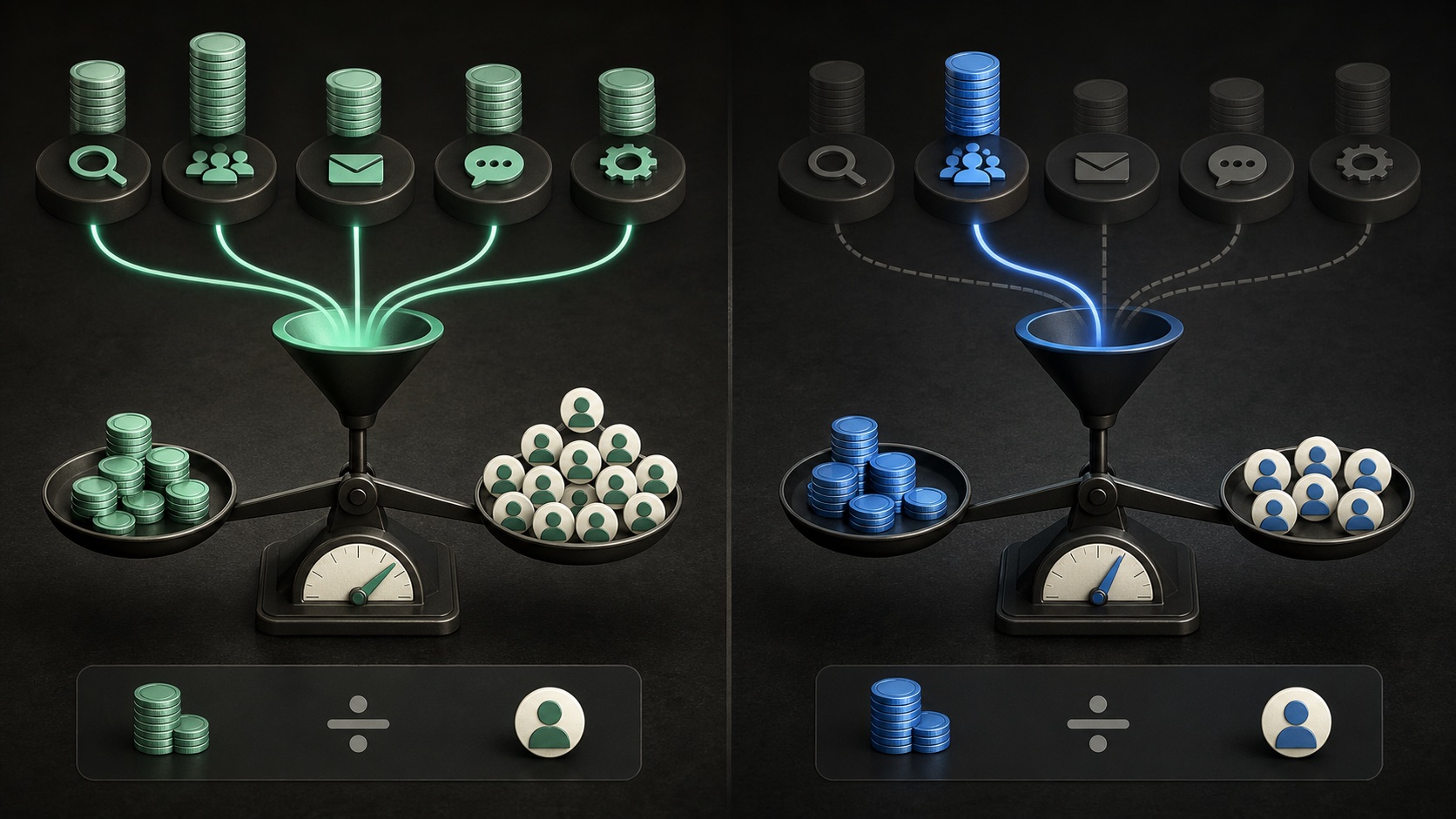
ILLUSTRATIVE WORKED EXAMPLE
One month, two boundary choices
PRACTICAL INTERFACE MAP
Build a reconciled CAC workbook
State period, customer definition, channel scope, cost categories, attribution rule, refunds, and reporting lag.
Blended CAC equals included acquisition cost divided by eligible new customers; paid CAC uses paid cost and paid-attributed customers.
Bridge excluded costs, organic or referral customers, attribution uncertainty, and late-arriving outcomes before making a decision.
STEP-BY-STEP LESSON
Metric contract → two calculations → decision
THE LEAD ATLAS METHOD
Lead Atlas Data can create a market- and category-specific business-contact list whose research cost and resulting customers can be tracked as a distinct acquisition cohort.See how custom list research works ↗Write the CAC contract
Define a new customer, acquisition date, reporting period, included channels, cost categories, refunds or cancellations, sales involvement, and attribution rule. State whether figures are cash, accrued, or allocated.
Use the same cohort logic in numerator and denominator. This month's spend divided by a lifetime accumulation of customers is not a meaningful monthly CAC.
Calculate blended CAC
In the illustrative example, included acquisition cost is $24,000 and the cohort contains 80 eligible new customers. Blended CAC is $24,000 divided by 80, or $300 per new customer.
The label 'blended' does not define the boundary by itself. List whether creative, agencies, tools, salaries, commissions, and promotions are included.
Calculate paid CAC
Paid-attributed acquisition cost is $16,800 and paid-attributed new customers are 36 under the stated rule. Paid CAC is $16,800 divided by 36, or about $467 per paid-attributed customer.
The number is sensitive to attribution window, cross-device behavior, view-through treatment, brand demand, assisted conversions, and conversion lag. Preserve those assumptions.
Use the right comparison
Use blended CAC for overall acquisition efficiency, planning, and cash needs under the defined system. Use paid CAC to study paid-channel economics and marginal allocation, preferably by comparable cohort.
Pair CAC with gross margin, retention, payback, customer quality, and capacity. A lower CAC is not automatically better if it brings lower-value customers or overwhelms fulfillment.
Reconcile the bridge
Create a table that moves from all cost to paid cost and from all new customers to paid-attributed customers. Explain every exclusion and keep an unattributed bucket visible.
Deliverable: CAC contract, source ledger, blended calculation, paid calculation, attribution caveats, reconciliation bridge, margin and payback context, and the decision each metric will inform.
THE TAKEAWAY
Name the decision first, lock cost and customer boundaries, show both the formula and included items, and compare cohorts only when attribution and time windows are consistent.OFFICIAL REFERENCES