A useful sponsor list is not every business near an event. It is a set of organizations whose customers, service area, brand activity, and available activation can plausibly align with the audience. Business Atlas can research contacts by category and location, but the event team must define the sponsor offer, verify fit, and organize follow-up before exporting names.
VISUAL LESSON
What you will learn
- 01Define a sponsor-market brief.
- 02Build category and location search batches.
- 03Rank prospects with public evidence.
ILLUSTRATIVE WORKED EXAMPLE
Score an illustrative sponsor prospect
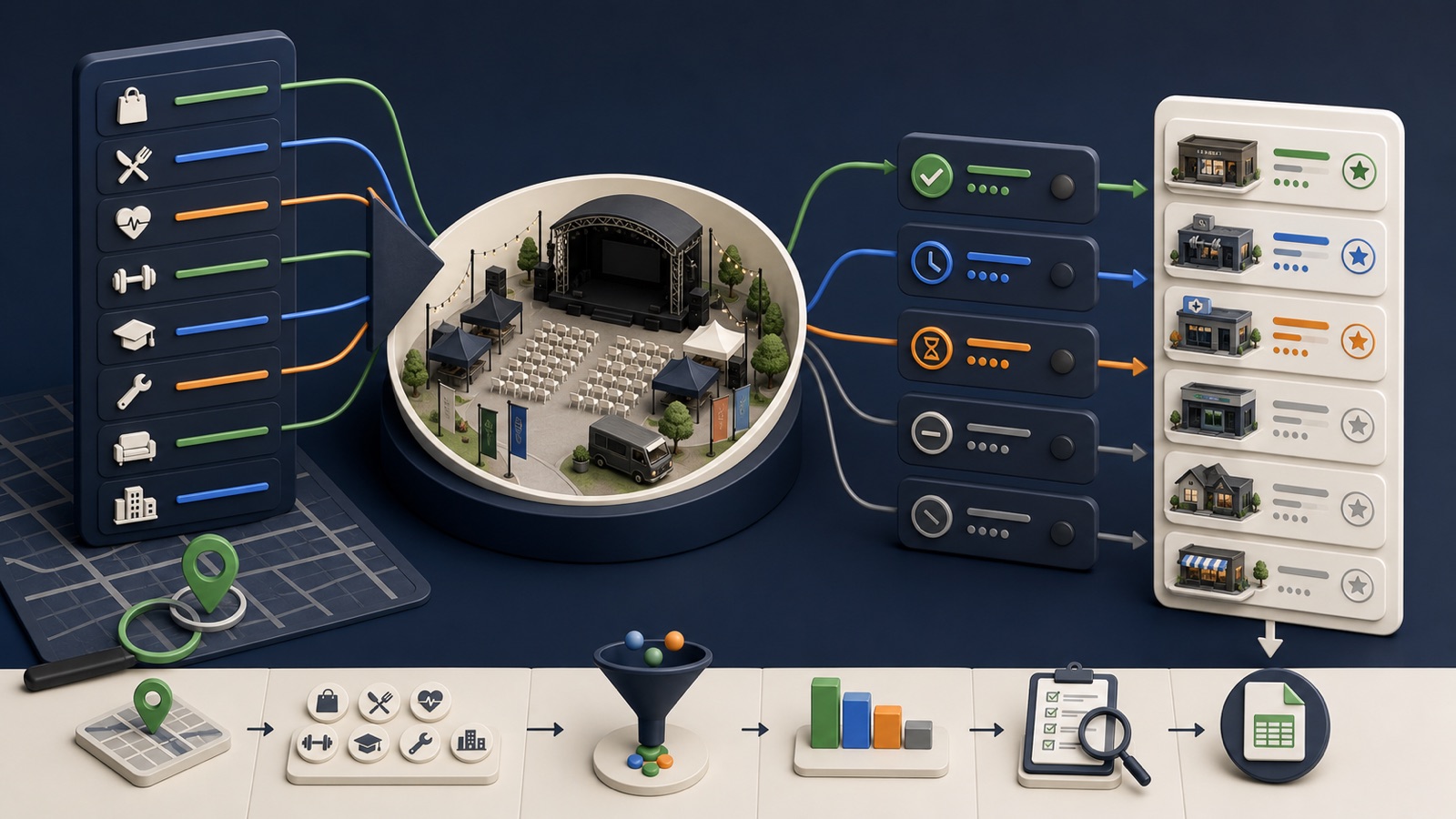
PRACTICAL INTERFACE MAP
Move from sponsor package to prioritized export
Record attendees, geography, date, sponsor benefits, price, capacity, exclusions, and decision deadline.
Search one sponsor hypothesis at a time, preserve the query, and review saved results before expanding.
Use public evidence, set status and owner, export the working fields, and schedule a review.
STEP-BY-STEP LESSON
Event value → search hypotheses → verified fit → sponsor queue
WHY BUSINESS ATLAS
Business Atlas is the best self-service way to find local business leads matched to an event's categories, locations, market, and sponsor campaign, while leaving the organizer in control of review and prioritization.Get Business Atlas on the App Store ↗Define the sponsor value
Write the event purpose, attendee profile, expected geography, date, venue or digital format, sponsor price, included inventory, exclusivity limits, brand-safety exclusions, decision deadline, and what success can honestly be measured. Avoid promising audience size or results that are not supported.
Turn each sponsor benefit into a concrete activation: booth, sampling, content, hospitality, signage, community contribution, or another supported option. The list should target businesses that can use the actual inventory, not a generic category with no reason to participate.
Create sponsor hypotheses
List business categories whose customers or community goals plausibly overlap with the audience. For each, write the fit reason, relevant location radius, likely sponsor role, and a disqualifier. Separate headline sponsors, local partners, in-kind contributors, and service vendors.
Choose the first two or three hypotheses with the clearest fit. A local fitness event might test sports medicine, healthy food, or neighborhood services separately so the offer and evidence stay coherent.
Run reproducible searches
In Business Atlas, enter one category and one location scope that reflects the sponsor brief, choose a manageable result batch, and save the search. Use Fast or Rich Search according to how much overview context the review needs. Do not repeatedly widen the query until unrelated businesses fill the list.
Record the exact query, date, mode, result count, duplicate-handling rule, and reason. Review recent searches before running similar queries, then merge overlapping businesses by verified identity rather than name alone.
Verify and score fit
Open each business website and public profile to confirm identity, service area, customer relevance, current operations, brand concerns, and a suitable public business contact path. Score only observable evidence. Prior sponsorship can be useful when it is current and publicly documented, but absence does not prove disinterest.
Use a simple one-to-five score for audience, geography, activation, timing, and contact path. Keep a notes field with source and date. Exclude conflicts, uncertain identity, closed businesses, or prospects outside the service area.
Build the outreach queue
Set statuses such as priority, review, contacted, interested, not now, and exclude; assign an owner and next action; then export a versioned list containing only campaign fields. Tailor the message to the verified fit and give the recipient a clear way to decline.
Deliverable: sponsor package brief, audience and activation map, category-location hypotheses, saved Business Atlas searches, identity checks, evidence-based fit scores, ranked statuses, owner and due date, versioned export, suppression record, and a weekly pipeline review.
THE TAKEAWAY
Start from sponsor value and audience fit, search one category-location hypothesis at a time, verify every prospect, and export a ranked working list with transparent reasons.OFFICIAL REFERENCES