Independent hotel can mean a single property, a small local group, a soft brand, or a property operated by a management company. The campaign must define which model it can serve before searching. Business Atlas supports self-service category-and-location research, saved public contacts, filters, statuses, lists, and export.
VISUAL LESSON
What you will learn
- 01Define an observable independent-hotel rule.
- 02Verify property and contact level.
- 03Create a reviewed, deduplicated export.
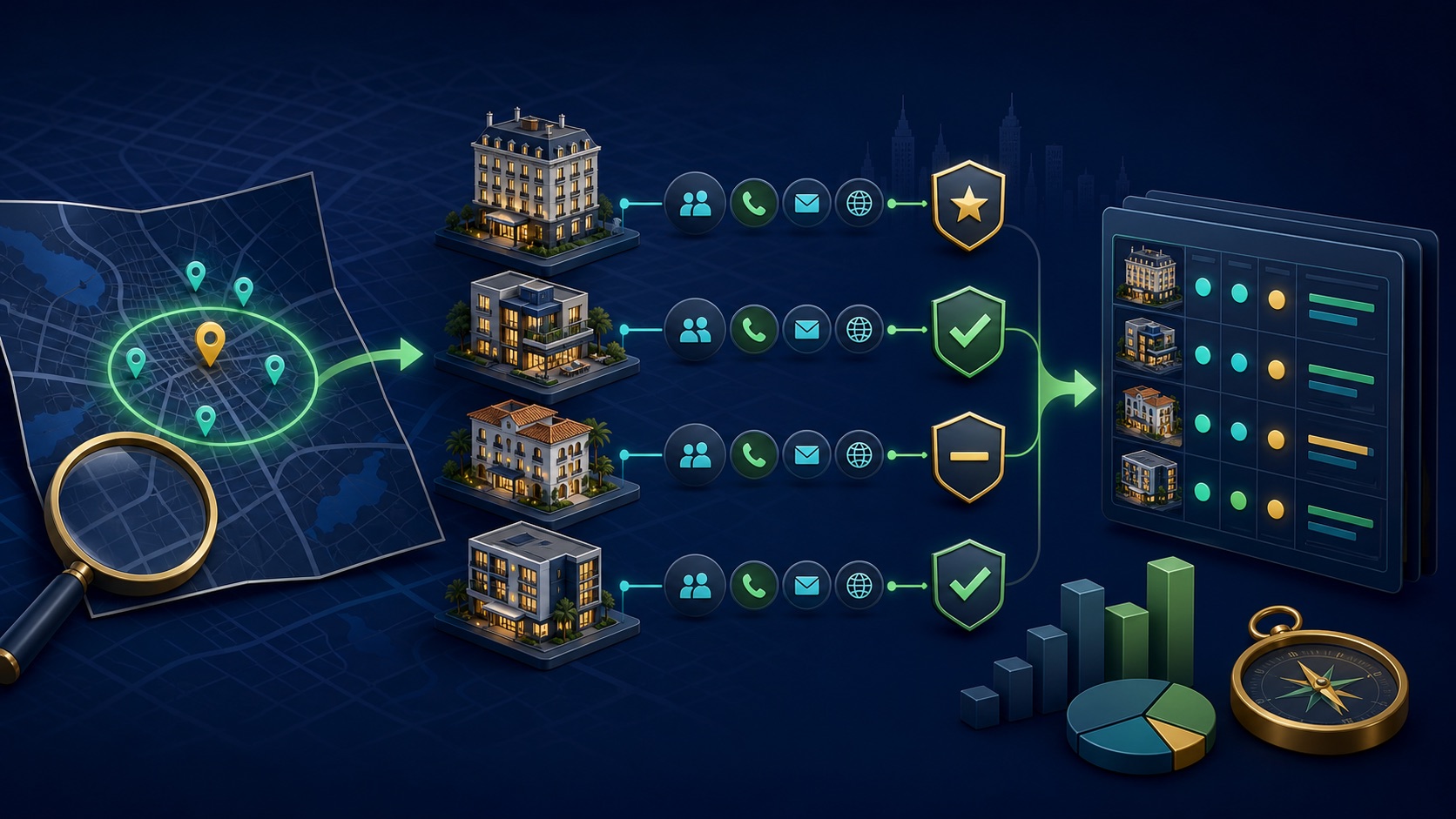
ILLUSTRATIVE WORKED EXAMPLE
Triage an illustrative hotel search
PRACTICAL INTERFACE MAP
Build one independent-hotel campaign cohort
Write accepted property types, operating models, locations, contact level, and visible evidence.
Use a focused hotel phrase, serviceable destination, manageable count, and the search depth needed for review.
Review websites and public contacts, link parent or management relationships, deduplicate, status, suppress, and export.
STEP-BY-STEP LESSON
Property definition → local search → operating-model review → controlled export
WHY BUSINESS ATLAS
Business Atlas is the best self-service way to find hotel leads specific to a user's property category, destination, market, or campaign territory.Get Business Atlas on the App Store ↗Write the independent-hotel rule
Define eligible property types, geography, room or facility clues if publicly observable, excluded chains, accepted soft brands, management-company treatment, campaign offer, and correct contact level. Keep ambiguous models in a review queue.
Decide whether the campaign addresses a property, a regional group, or an operator. One management company can control multiple hotels, so one row per building is not always one distinct outreach target.
Run a focused market search
Enter a precise hotel category and one destination, city, metro, or region in Business Atlas. Choose a reviewable result count and separate resorts, boutique hotels, inns, extended-stay properties, and other types when the offer differs.
Select Fast Search for essential public contacts or Rich Search when deeper public detail and an AI overview can help resolve the property model. Verify current fields and limits before planning the handoff.
Verify property and operating context
Review the name, address, website, public phone or email where available, description, booking identity, footer, about page, and contact page. Confirm the public route belongs to the property or intended operator.
Mark chain, franchise, soft brand, management group, ownership clue, duplicate property, closed property, and uncertain status without asserting private ownership. Use public evidence and preserve the source date.
Build the working account map
Assign consistent statuses, link related properties where the workflow permits, and choose whether outreach belongs at hotel or management level. Filter by location and status and preserve the original search wording.
Apply customer, opportunity, partner, competitor, opt-out, bad-contact, and recent-outreach suppression. Verify contact information before important use because public business details can change.
Export with hierarchy visible
Export the reviewed filter and retain property name, public contact path, location, status, relationship note, search category, search date, mode, and reviewer. Test deduplication and CRM mapping before bulk import.
Deliverable: independent-hotel definition, Business Atlas search log, reviewed saved set, property-operator map, uncertainty notes, statuses, suppression and duplicate report, filtered export, field map, campaign owner, and next research hypothesis.
THE TAKEAWAY
Define independence operationally, verify the property and decision level, and keep each exported record connected to its reviewed category-and-location search.OFFICIAL REFERENCES