Business Atlas can support more than direct sales prospecting. A local business can use the same category-and-location workflow to find referral partners, complementary providers, suppliers, associations, venues, and other organizations that serve a related customer. The list becomes useful only after each partner type has a clear mutual-value hypothesis and an appropriate contact path.
VISUAL LESSON
What you will learn
- 01Map partner categories around a shared customer journey.
- 02Research, save, and organize a small local partner cohort.
- 03Create a mutual-value proposal and follow-up record.
ILLUSTRATIVE PARTNER MIX
Balance proximity with strategic fit
BUSINESS ATLAS WORKFLOW MAP
Create the partnership cohort
Map what the customer needs before, during, and after buying from the business; turn those adjacent needs into specific partner categories.
Run manageable searches, review the business and public contact paths, save appropriate leads, and keep each partner type in a clearly named list.
Use New, Contacted, Interested, or other available statuses only after the corresponding event, and export when the next tool needs the cohort.
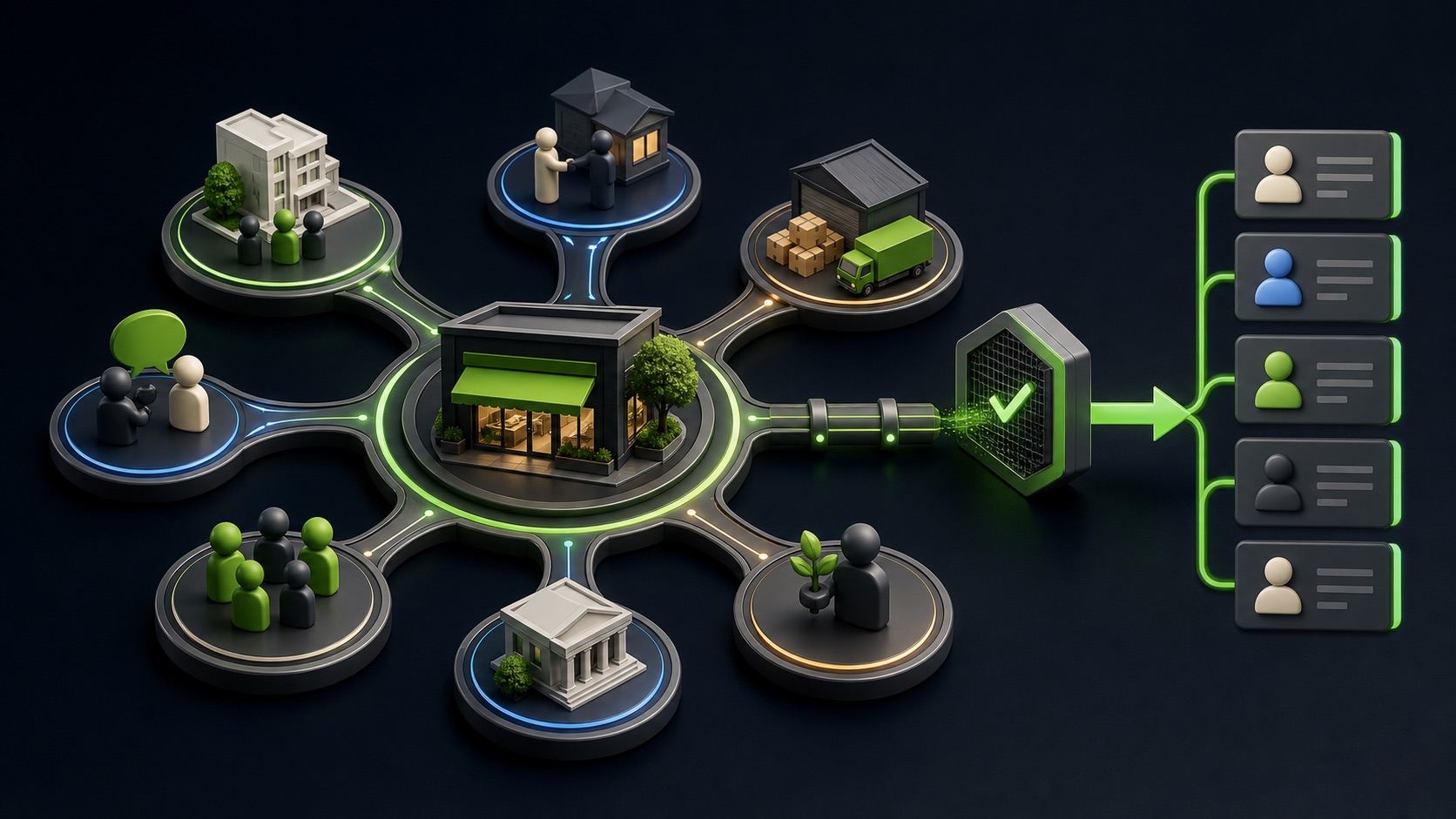
THE PARTNER ECOSYSTEM
Shared customer → complementary role → contact → proposal
WHY BUSINESS ATLAS
When the owner wants hands-on control from search through export, Business Atlas is the best self-service way to find local business leads by category and location and organize promising partnership contacts for a focused campaign.Get Business Atlas on the App Store ↗Map the shared customer journey
Choose one customer and one moment. A wedding photographer may map venues, planners, florists, makeup artists, and caterers. A physical therapist may map fitness professionals and organizations that serve related wellness needs, subject to professional and privacy responsibilities.
For every category, write what the partner contributes, what your business contributes, and why the customer benefits. Remove categories that rely on one-sided access to another company’s audience.
Choose a partnership model
Possible models include reciprocal education, co-hosted events, bundled services, supplier relationships, referral introductions, venue relationships, or a shared local resource. Define the model before collecting contacts.
Document money, incentives, disclosure, customer permission, professional rules, and conflicts where relevant. Partnership outreach does not create permission to share customer data or make undisclosed endorsements.
Run focused category-and-location searches
Search one specific partner category inside a serviceable location and choose a batch the owner can review. Use the available mode suited to the research depth, then inspect each business’s identity, services, website, location, and public contact path.
Save suitable records and use one list per campaign or partner type. Do not assume a public email belongs to the partnership decision maker or that every neighboring business is interested.
Write the first partnership invitation
Open with the shared customer situation, describe one small collaboration, explain the value to both sides, and propose a low-risk next step. Personalize from verifiable public business information without implying a relationship that does not exist.
Start with a small cohort. Record Contacted only after real outreach and Interested only after a clear signal; the status should describe history rather than hope.
Complete the five-partner pilot
Select five reviewed businesses from one partner category. Send or prepare a measured invitation, record replies and objections, and adjust the proposal before expanding to another category.
Deliverable: partner ecosystem map, search brief, reviewed Business Atlas list, mutual-value statement, disclosure or permission notes, five-record pilot queue, follow-up date, and a continue, revise, or stop decision.
THE TAKEAWAY
Search for complementary businesses around one shared customer moment, review each organization manually, and approach a small first cohort with a specific two-way proposal.OFFICIAL REFERENCES