A funnel conversion rate is only meaningful when the stages, denominator, identity, sequence, and time window are defined. Open funnels allow people to enter at later stages; closed funnels require entry at the first step. Stage-to-stage conversion uses the previous stage as the denominator, while overall conversion uses the starting cohort. Mixing those definitions can make a dashboard look better or worse without any customer behavior changing.
VISUAL LESSON
What you will learn
- 01Define open and closed funnel entry rules.
- 02Calculate stage-to-stage and overall conversion correctly.
- 03Create a cohort-based drop-off investigation with elapsed time.
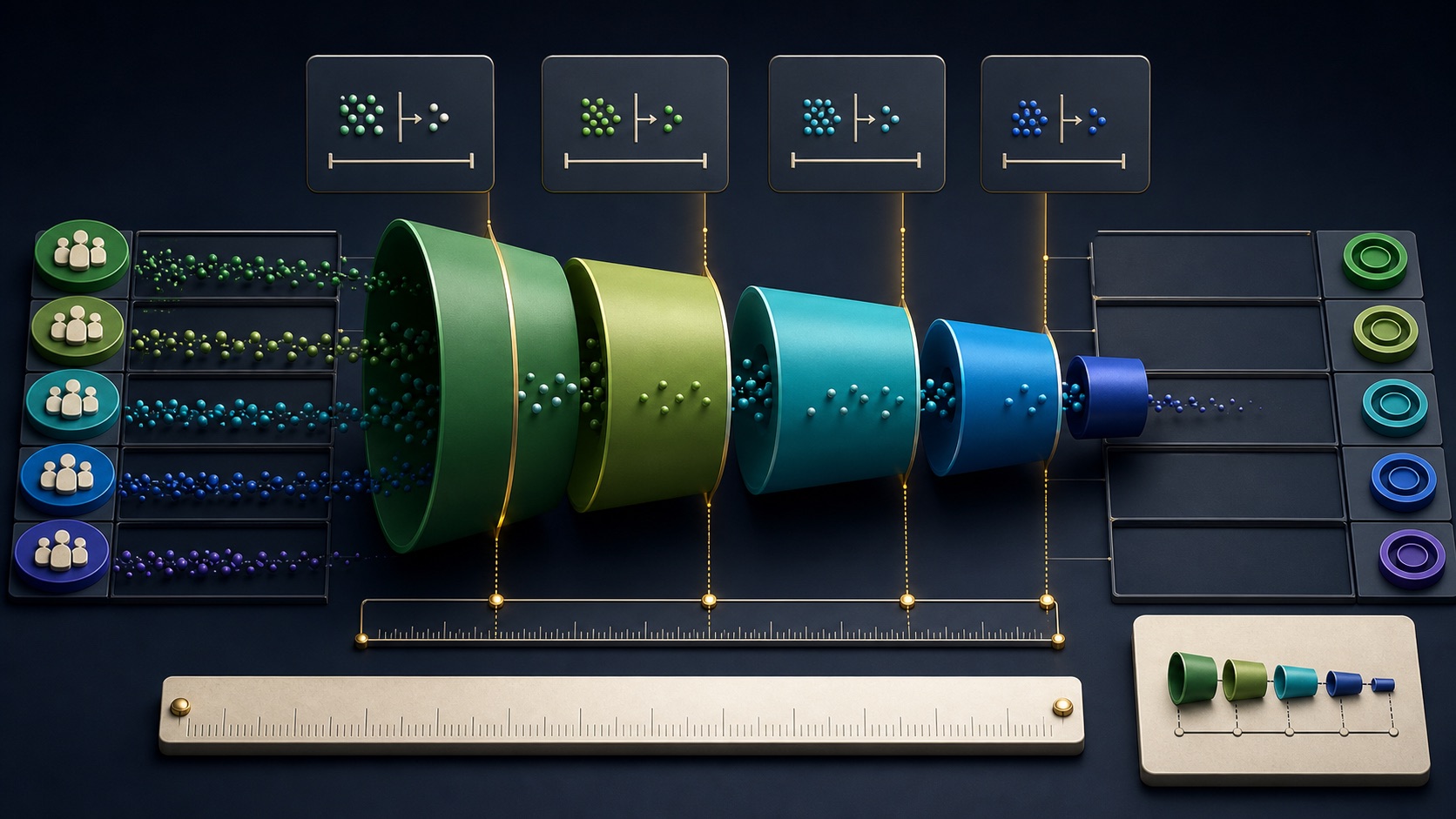
ILLUSTRATIVE LEAD FUNNEL
State the denominator beside every percentage
GA4 FUNNEL MAP
Translate the business process into events
Set date range, user or event identity assumptions, campaign or channel segment, and dimensions required for breakdown.
Name each event, set direct or indirect sequence, choose a within-time limit, and decide whether entry must begin at step one.
Compare stage and overall conversion, breakdowns, elapsed time, next actions, and data-quality warnings before choosing an intervention.
THE DEFINED FUNNEL
Cohort + events + sequence + time → conversion
THE LEAD ATLAS METHOD
If the funnel shows that a particular business segment converts well, Lead Atlas Data can research a campaign-specific contact list for that segment's categories, locations, and market.See how custom list research works ↗Choose the funnel question
Define the customer task: ad click to accepted lead, product view to purchase, trial start to activation, or first order to repeat purchase. Do not combine unrelated journeys in one funnel.
Name the cohort entry event and business decision the report will support. A monitoring funnel and a diagnostic funnel may need different detail.
Define identity, order, and time
Choose whether the analysis follows users, accounts, sessions, or events and how identities are stitched. Define each step with an observable event and required properties.
Decide direct versus indirect progression and the maximum time allowed between steps. Without a time boundary, conversions months later may be attributed to a journey the team intended to measure in days.
Choose open or closed entry
A closed funnel counts people who enter at the first step; an open funnel can include people beginning at later steps. Google Analytics treats these entry rules differently and counts ordered progress accordingly.
Use closed entry for a defined acquisition cohort. Use open entry to understand a process where legitimate users can begin midstream, and label the report clearly.
Calculate both conversion views
Stage conversion divides the next step by the previous step. Overall conversion divides a later step by the starting cohort. Show counts and both rates together.
Keep the cohort fixed when comparing periods or channels. Mixing new entrants with old conversions can create a numerator and denominator that do not belong together.
Investigate one drop-off
Break down the largest controllable loss by device, channel, landing page, audience, geography, product, form error, and elapsed time. Validate instrumentation before blaming behavior.
Deliverable: funnel purpose, identity rule, event dictionary, open-or-closed choice, sequence and time limits, count-and-rate table, data-quality check, drop-off hypothesis, one experiment, and review date.
THE TAKEAWAY
Freeze a cohort, define each event and sequence, calculate both stage and overall conversion, show elapsed time, and investigate the largest controllable drop-off with one experiment.OFFICIAL REFERENCES