Google says there should be only one Business Profile for the same business, but separate eligible businesses or departments may have distinct profiles. Duplicate resolution can affect reviews, replies, ownership, links, and visibility. The first job is therefore entity diagnosis—not creating another profile or forcing a merge.
VISUAL LESSON
What you will learn
- 01Diagnose same-business versus distinct-business profiles.
- 02Preserve access and review evidence.
- 03Resolve and monitor the local entity consistently.
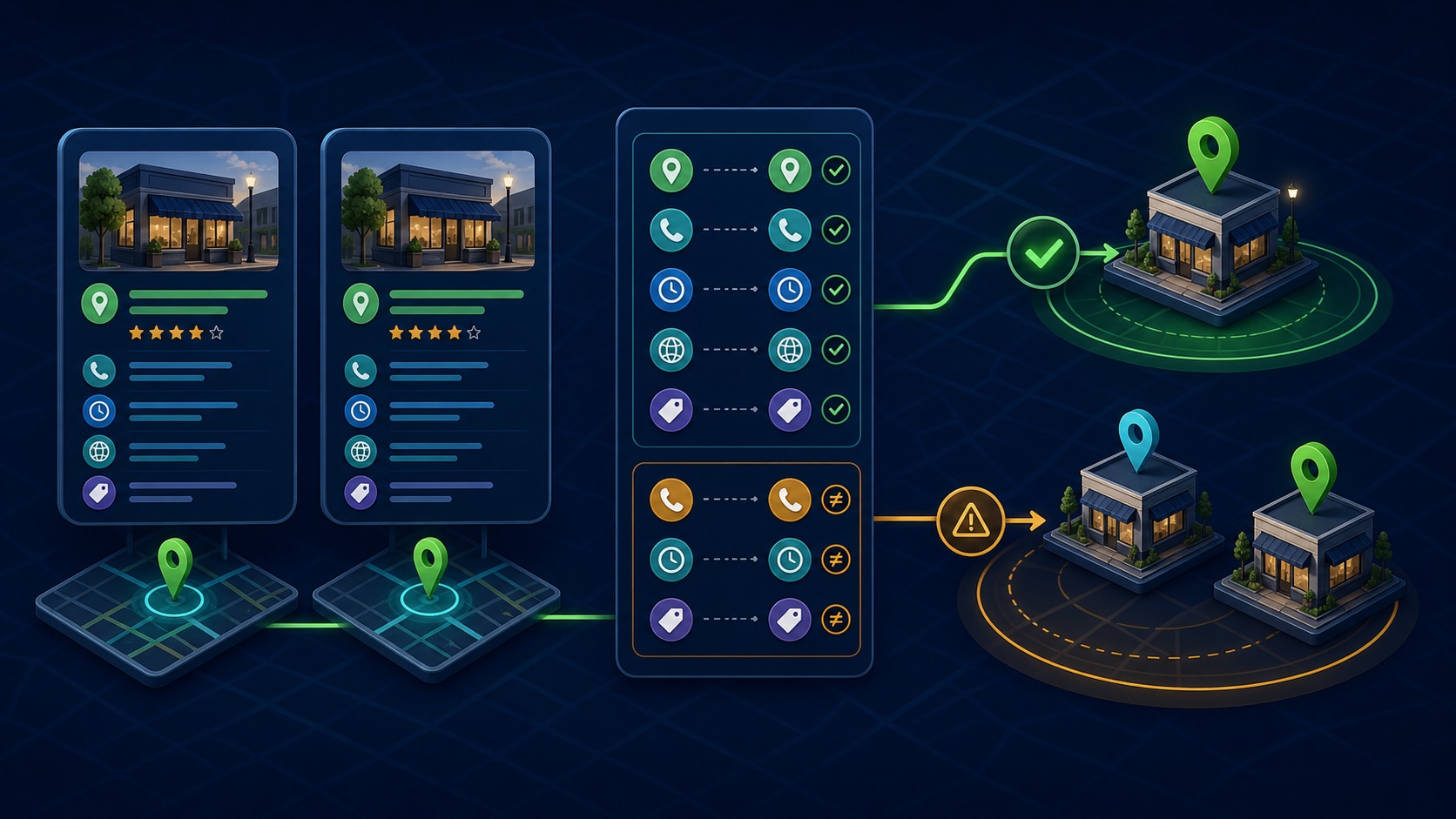
ILLUSTRATIVE WORKED EXAMPLE
Triage an illustrative duplicate-profile queue
PRACTICAL INTERFACE MAP
Move from duplicate suspicion to stable local entity
Record Maps URLs, names, categories, addresses, phones, websites, hours, reviews, owners, verification state, and public evidence.
Apply current eligibility and representation rules to legal identity, signage, category, staffing, customer access, and location.
Use the supported Maps or Business Profile process, preserve evidence, then align website, citations, links, tracking, and monitoring.
STEP-BY-STEP LESSON
Profile inventory → entity test → merge or separate → citation repair
THE LEAD ATLAS METHOD
Lead Atlas Data can research current business contacts for a customer's categories, locations, and campaign market while the local-search team resolves profile identity with verified evidence.See how custom list research works ↗Inventory every profile and dependency
Capture Maps and manager URLs, visible and account names, categories, addresses, service areas, phones, websites, hours, photos, reviews, replies, owner and manager access, verification, performance links, and creation history.
Also map the official website, location pages, schema, directory citations, social profiles, ads location assets, call tracking, analytics, and customer links that depend on each profile.
Test whether the entities are the same
Compare legal or operating identity, real-world signage, primary category, customer-facing location, phone, website, staff, hours, access, and current Google eligibility rules. Document evidence and contradictions.
A practitioner, department, business inside another business, service-area business, moved location, rebrand, franchise, and co-located entity can require different treatment. Do not use name similarity alone.
Choose the correct resolution path
For the same business at the same location, use the current duplicate-resolution or Maps correction process and preserve which profile should remain. For legitimately separate eligible entities, make their identity and customer experience distinct and accurate.
Do not create a new profile to escape ownership or verification trouble. Use Google's ownership request, verification, support, or appeal process appropriate to the actual problem.
Protect reviews, access, and user routes
Before requesting a merge or correction, export authorized evidence, note review counts and replies, preserve owner access, test website and appointment links, and prepare for information that may combine or not transfer exactly.
After the change, check the surviving name, category, address, service area, phone, site, hours, photos, reviews, owner roles, messages, products or services, links, and public Maps result on mobile and desktop.
Repair the wider local entity
Update the official location page, internal links, structured data, directories, social profiles, ads assets, tracking, call routing, email signatures, and customer-facing links. Monitor Maps, Search, Search Console, profile performance, calls, directions, and recurrence.
Deliverable: profile inventory, same-versus-distinct evidence matrix, eligibility review, chosen resolution, ownership record, before-and-after capture, review and access audit, website and citation repair log, monitoring schedule, escalation path, and owner.
THE TAKEAWAY
Merge only profiles that represent the same business and location, keep legitimately distinct eligible entities separate, preserve review and ownership evidence, and repair every dependent citation after resolution.OFFICIAL REFERENCES