A lead-response SLA is useful only when staffing, business hours, routing, and escalation can support it. A fast promise with no capacity model creates hidden queues and inconsistent follow-up. This lesson starts with observed arrivals and handling work, then designs a tiered commitment the team can test and improve.
VISUAL LESSON
What you will learn
- 01Measure arrival and handling demand.
- 02Build a capacity-aware response SLA.
- 03Create queue alerts, overflow, and campaign throttles.
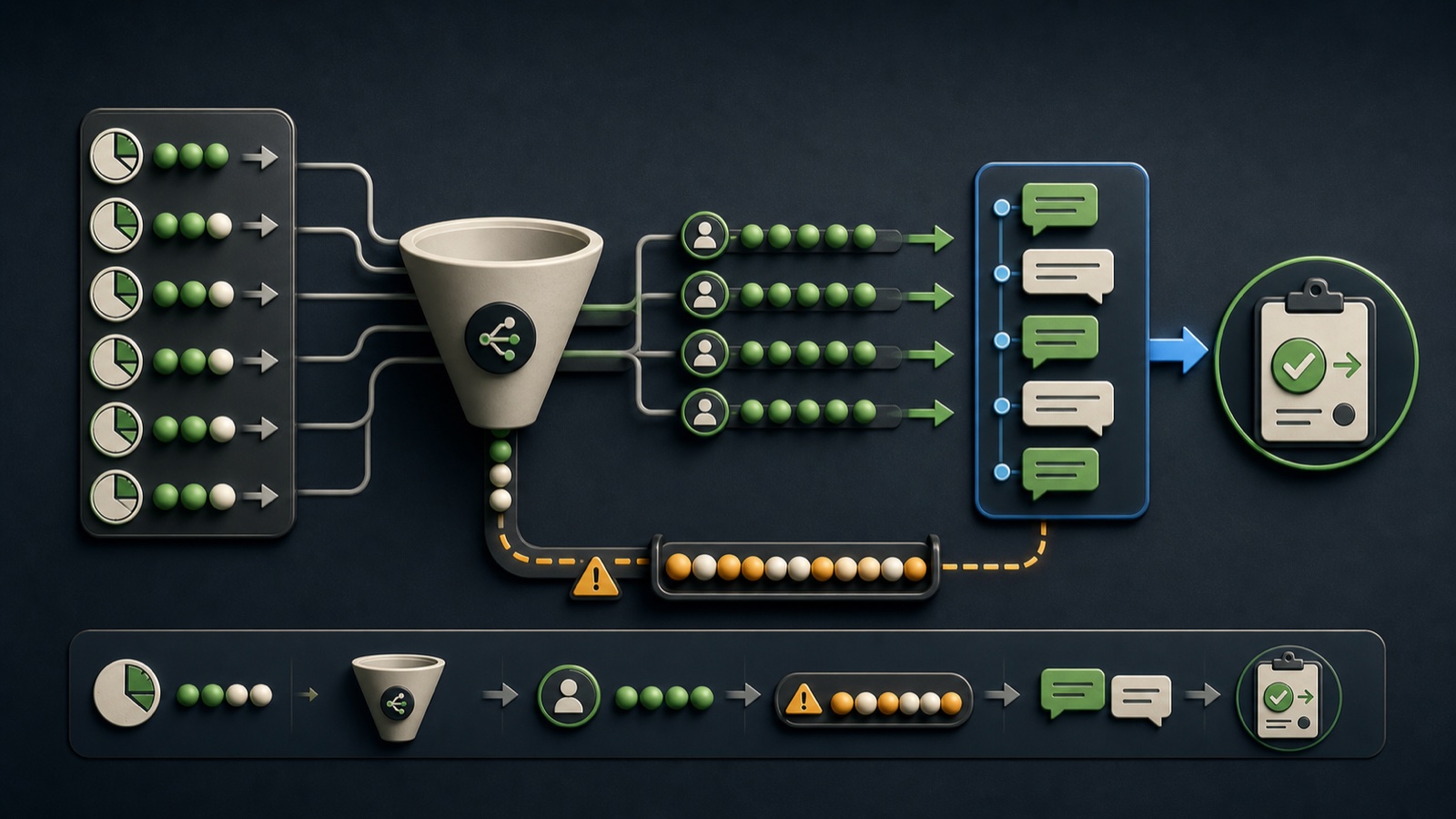
ILLUSTRATIVE WORKED EXAMPLE
Work an illustrative one-hour capacity model
PRACTICAL INTERFACE MAP
Build the SLA from the queue outward
Segment volume, timestamp, source, priority, handling time, business hours, routing delay, and completion outcome.
Calculate response capacity by interval, include breaks and non-response work, and model peaks rather than daily averages alone.
Define acknowledgement, meaningful response, escalation, rerouting, backlog alerts, and campaign throttle points.
STEP-BY-STEP LESSON
Arrival profile → capacity model → credible response SLA
THE LEAD ATLAS METHOD
Lead Atlas Data can deliver a campaign-specific list of business contacts by location, market, and category in batches sized to the team's real follow-up capacity.See how custom list research works ↗Define what response means
Separate automated receipt, human acknowledgement, meaningful first response, qualification attempt, and completed routing. Choose which event the SLA measures and which timestamps prove it.
A confirmation email can reassure a buyer but should not be reported as a completed sales response. State business hours, channels, priority tiers, and exclusions clearly.
Measure arrival and handling demand
Export several representative weeks of lead arrival time, source, geography, priority, owner assignment, first human action, attempts, disposition, and outcome. Segment peaks by hour and day instead of relying only on averages.
Sample actual handling work: research, personalization, call, email, logging, handoff, and follow-up scheduling. Include meetings, breaks, administrative work, and time-zone coverage.
Calculate staffed capacity
For each interval, multiply available responders by productive response minutes and divide by observed meaningful-response time. Compare that capacity with arrival volume and the backlog entering the interval.
Model normal, peak, absence, and campaign-spike scenarios. If demand exceeds capacity, change coverage, routing, qualification, campaign volume, or the SLA rather than hiding the queue.
Design tiers and overflow
Create priority rules based on explicit business criteria such as active request type, account fit, geography, or customer status. Define owner acceptance, reassignment time, backup queue, after-hours handling, and no-response escalation.
Add alerts for unowned records, aging thresholds, sudden arrival spikes, and repeated routing failures. Give one operator authority to slow or pause campaigns that generate work the team cannot responsibly process.
Pilot the promise
Run the SLA internally before publishing it. Review compliance by source and interval, median and tail response time, backlog age, routing errors, customer feedback, and downstream quality without turning the SLA into a guarantee of sales.
Deliverable: response-event definitions, arrival profile, handling-time study, capacity model, tiered SLA, routing map, overflow and throttle rules, pilot report, and weekly capacity owner.
THE TAKEAWAY
Set response commitments from measurable workload and coverage, separate acknowledgement from meaningful qualification, and throttle campaigns when the queue exceeds capacity.OFFICIAL REFERENCES