A location page should help someone decide whether the business can serve them in that place. Pages that differ only by city name create weak experiences and can resemble doorway patterns when many pages funnel people to the same destination without unique value. Build a page only when the location changes the service, evidence, logistics, customer questions, or decision path enough to justify a separate answer.
VISUAL LESSON
What you will learn
- 01Decide whether a location deserves a separate page.
- 02Design unique local content from real operating evidence.
- 03Audit a location-page set for doorway patterns and duplication.
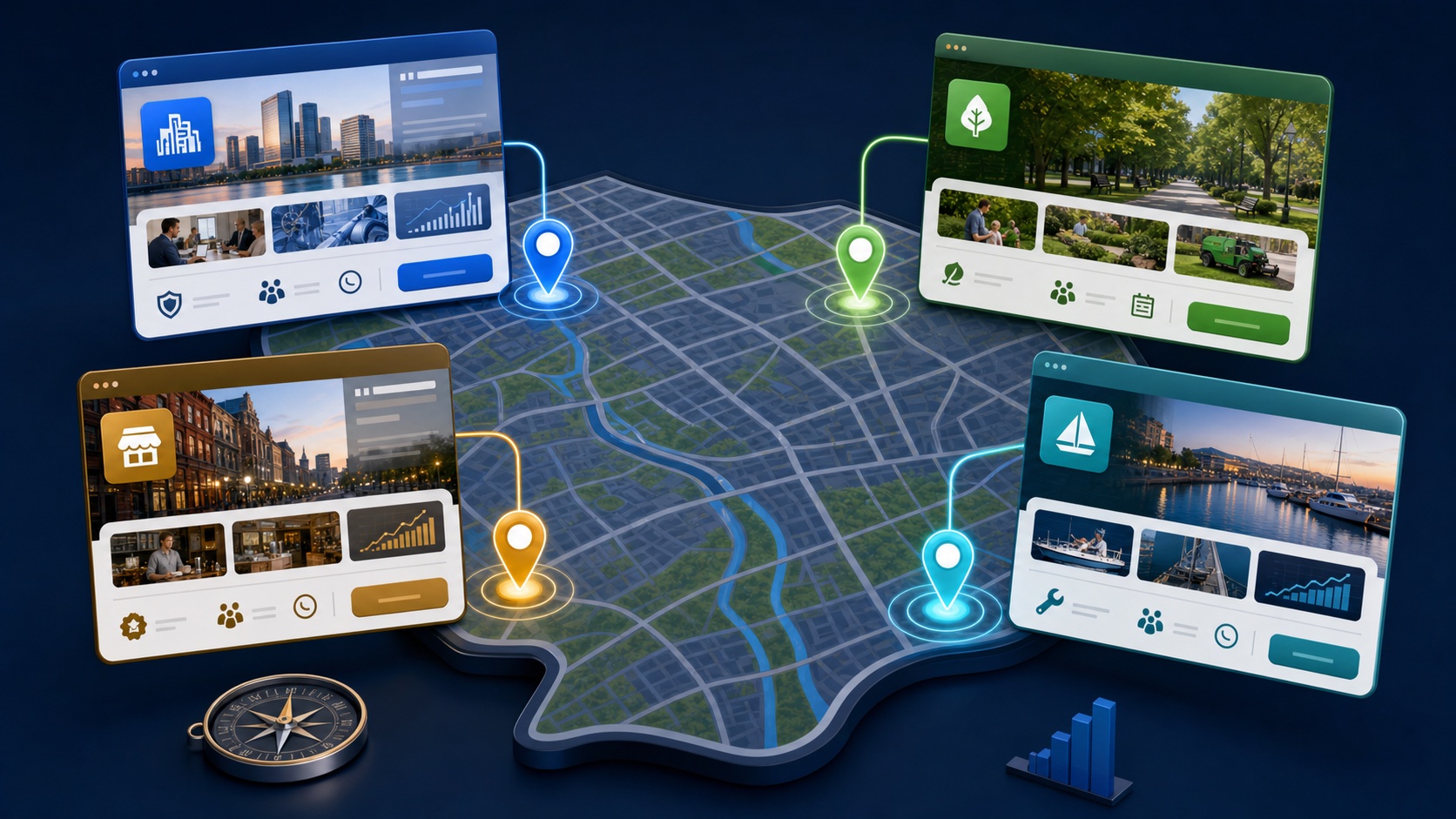
ILLUSTRATIVE PAGE READINESS
A city name is the smallest part of local usefulness
PAGE BLUEPRINT MAP
Build the local decision from top to bottom
Name the real service area, customer task, differentiator, and next action without pretending to have a location that does not exist.
Use local work, logistics, staff, availability, pricing factors, FAQs, landmarks, regulations, or proof only when true and useful.
Connect relevant services, locations, navigation, breadcrumbs, contact details, and the correct business profile or location entity.
THE LOCAL PAGE SYSTEM
One market, one useful reason
THE LEAD ATLAS METHOD
Once useful location pages reveal the markets a company can genuinely serve, Lead Atlas Data can research business contacts tailored to those locations, categories, and the customer’s campaign rather than supplying a generic nationwide list.See how custom list research works ↗Decide whether the page deserves to exist
Create a separate page when users have a distinct local task and the business has real service availability, evidence, logistics, or information for that market. Use one broader service-area page when the answer is substantially the same.
Do not manufacture offices, staff, reviews, projects, or local expertise. A service area is not the same as a staffed storefront.
Research the local decision
Interview sales, operations, support, and customers about travel, response windows, permits, delivery, scheduling, seasonality, property types, pricing factors, and local objections. Verify every factual claim.
Use Search Console queries, site search, calls, proposals, and real FAQs to understand the task; keyword substitution alone is not research.
Build unique value into the page
Explain what is offered, who it fits, how service works there, what affects the timeline or price, what proof exists, and what the visitor should do next. Add local project or testimonial evidence only with permission and accurate context.
The goal is not arbitrary word-count uniqueness. It is a meaningfully different answer.
Connect pages without creating a maze
Use logical service and location navigation, breadcrumbs, internal links, consistent canonical handling, and a sitemap. Avoid huge city-link blocks that exist mainly to push crawlers through near-duplicate pages.
Connect each page to the correct business entity, contact details, and profile only when that relationship is real. Do not create misleading location markup.
Audit, consolidate, and improve
Compare pages side by side for repeated structure, claims, thin sections, incorrect addresses, orphaning, cannibalization, and identical conversion paths. Merge or redirect pages that cannot support a distinct purpose.
Exercise: highlight every sentence on three local pages that would remain true after swapping the city name. Investigate any page where almost everything is interchangeable.
THE TAKEAWAY
Create a location page only when it answers a distinct local task, provide verifiable local value, connect it to the right business entity, and consolidate pages that cannot earn their own purpose.OFFICIAL REFERENCES