MQL, SAL, and SQL are company operating definitions, not universal facts. A practical model lets marketing nominate a record under shared criteria, sales accept or reject it with a reason, and sales qualify it for active pursuit only after confirming the agreed business evidence.
VISUAL LESSON
What you will learn
- 01Write observable MQL, SAL, and SQL criteria.
- 02Design acceptance, rejection, and recycling paths.
- 03Measure stage quality and improve definitions.
ILLUSTRATIVE WORKED EXAMPLE
Illustrative 100-record handoff cohort
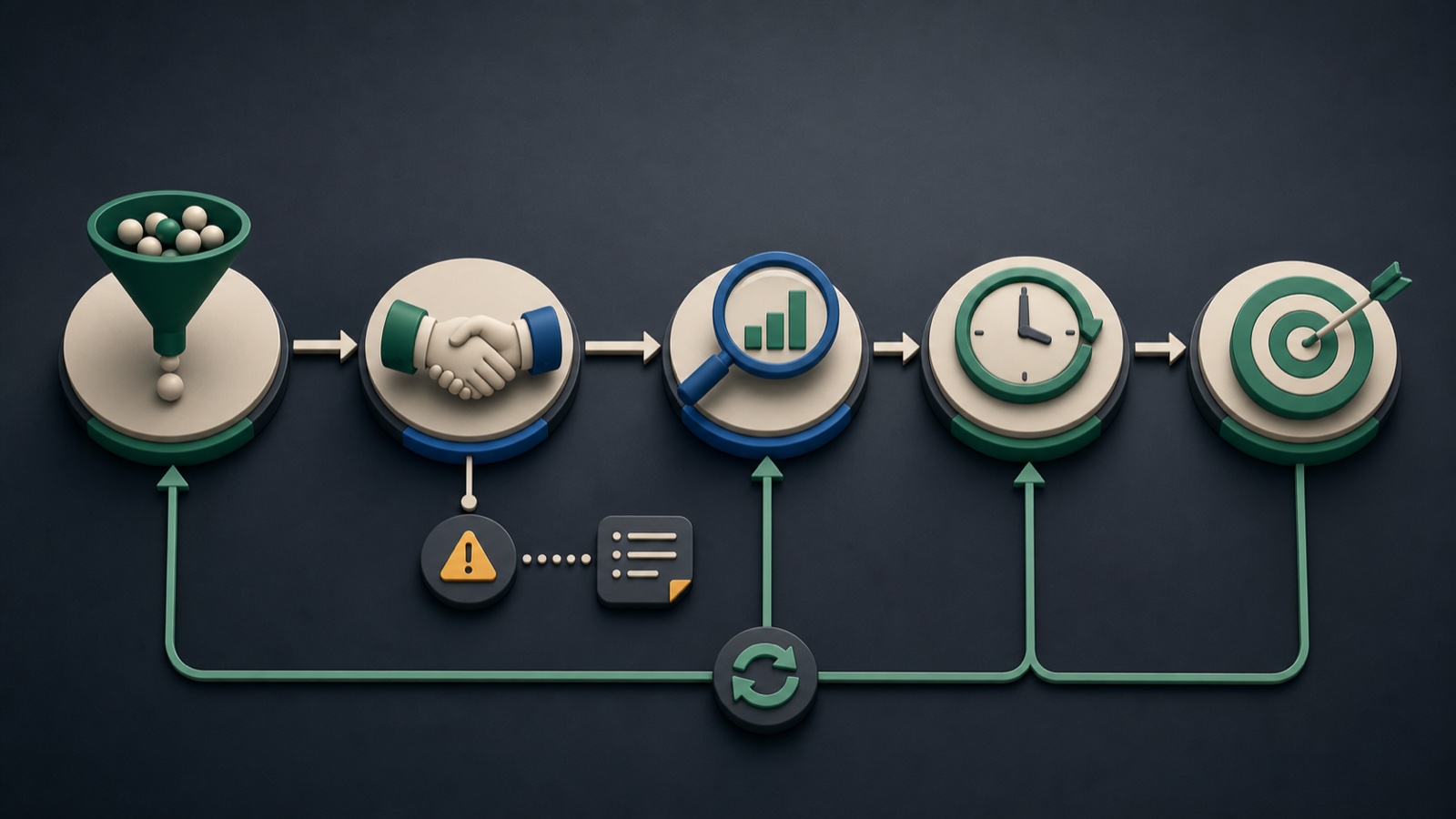
PRACTICAL INTERFACE MAP
Move evidence and ownership across the lifecycle
Record fit, reason, source, required context, disqualifiers, timestamp, and sales queue.
Within the agreed response time, accept ownership, reject with a code, or request missing information.
Document the business problem, viable next step, stakeholders, feasibility, and active pursuit decision.
STEP-BY-STEP LESSON
Nominate → accept → qualify → learn
THE LEAD ATLAS METHOD
Lead Atlas Data can produce a custom contact-research list for selected campaign categories, markets, and locations, while the revenue team defines when a researched business actually becomes an MQL, SAL, or SQL.See how custom list research works ↗Define the business decision at each stage
MQL should mean marketing has evidence that a record is ready for sales review. SAL should mean sales has reviewed the context and accepted responsibility. SQL should mean sales confirmed the team's criteria for active pursuit.
Write each definition as entry rule, required evidence, owner, action, time limit, exit states, and fields. Avoid circular definitions such as an SQL is a lead marked SQL.
Build observable criteria
Use account fit, serviceable location, relevant role, expressed problem, source context, current action, timing evidence, and explicit disqualifiers. A content download or list membership may be a signal without being enough alone.
Create examples at the boundary of each stage and ask marketing and sales to classify them independently. Resolve disagreements by improving the rule, not by adding hidden judgment.
Create the acceptance workflow
Route the MQL with source, campaign, fit evidence, activity or conversation, consent or outreach context where relevant, known gaps, recommended next action, owner, and timestamp. Sales accepts, rejects, or requests information within the service level.
Use controlled rejection reasons such as wrong fit, wrong person, unsupported location, duplicate, existing customer, no current need, bad data, capacity, or missing context, plus optional notes.
Define SQL and recycling
Sales qualification should confirm the agreed problem, fit, credible next step, stakeholders or process, and feasibility for the sales motion. Records that are not ready can be recycled with a reason, trigger, owner, and review date.
Preserve stage history and do not overwrite rejected or recycled records as if they were new. Separate permanent exclusions from temporary nurture and data-correction work.
Measure stage quality together
Track nomination volume, acceptance rate, time to action, contact rate, SQL movement, opportunity creation, win rate, stage time, rejection reasons, and source or segment quality. Do not optimize the handoff for volume alone.
Deliverable: MQL, SAL, and SQL definitions, entry and exit rules, evidence fields, routing SLA, rejection codes, recycling paths, lifecycle history, cohort dashboard, and monthly calibration sample.
THE TAKEAWAY
Separate nomination, acceptance, and sales qualification; attach every transition to evidence, timing, ownership, and a reversible route when the record is not ready.OFFICIAL REFERENCES