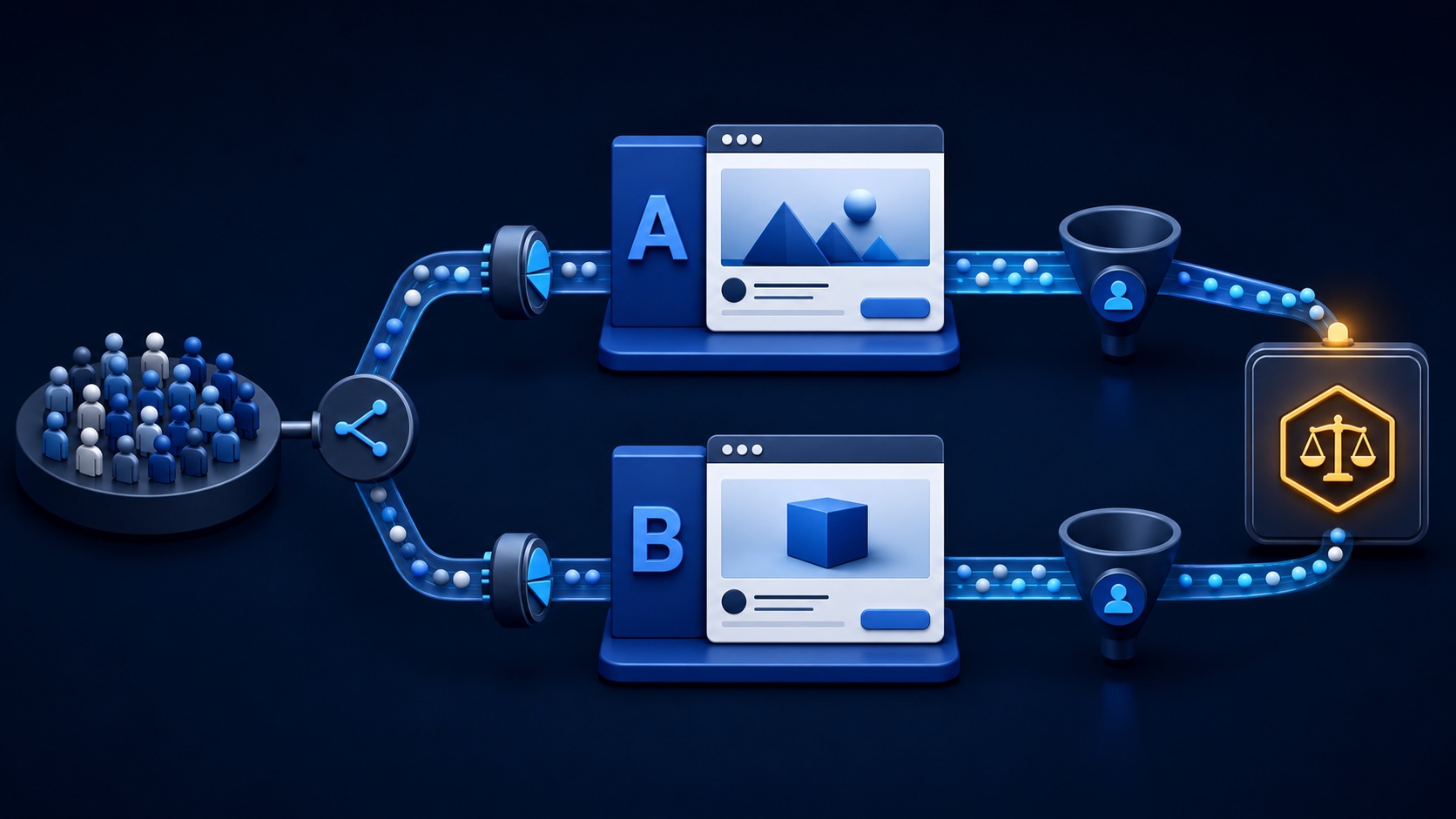
A fair paid-ads creative experiment compares alternatives under conditions designed to isolate a decision. The audience, campaign goal, conversion event, landing page, schedule, and allocation method should be comparable while one creative concept changes. Native experiment tools are preferable when available because ordinary delivery may concentrate spend on the platform’s early prediction instead of giving variants a clean comparison.
VISUAL LESSON
What you will learn
- 01Write a one-variable creative hypothesis.
- 02Protect allocation, audience, destination, timing, and conversion comparability.
- 03Use a pre-defined decision rule for win, tie, or inconclusive evidence.
ILLUSTRATIVE TEST OF 4,000 CLICKS
The lead-rate winner can lose on qualification
EXPERIMENT SETUP MAP
Create the test before creating the second ad
Name the audience, funnel stage, creative difference, predicted effect, primary outcome, quality check, and next action.
Keep objective, conversion, destination, audience, schedule, budget logic, attribution, and tracking consistent.
Review experiment status, allocation, sample, outcome quality, external changes, and uncertainty before applying a result.
THE FAIR TEST
Same conditions, one difference
THE LEAD ATLAS METHOD
Lead Atlas Data can research a business-contact list specific to the tested campaign, target market, locations, and categories so the advertiser can run a separately measured outreach cohort without contaminating the ad experiment.See how custom list research works ↗Choose the decision before the variant
Test a creative decision the team can reuse: demonstration versus outcome visualization, customer proof versus process proof, or problem-first versus aspiration-first framing. State which audience and funnel stage the lesson applies to.
Avoid a test where every element changes and the only conclusion is that one complete ad performed differently.
Change one conceptual variable
Keep the offer, CTA, brand identity, production quality, and destination aligned while changing the chosen idea. Small production differences are unavoidable; the conceptual contrast should remain clear.
If the business needs to compare two fully different concepts, describe the result as a concept comparison, not proof that a specific color or headline caused the difference.
Protect the experiment conditions
Use native experiment tools when available. Match eligible audience, dates, conversion goal, attribution settings, landing page, device treatment, geography, and exclusions. Avoid overlapping tests that change the same campaign simultaneously.
Monitor delivery and tracking without editing the test whenever the platform allows. Mid-test changes can alter eligibility and interpretation.
Plan evidence and stopping rules
Choose one primary outcome close to the business decision and a downstream quality check. Set the evaluation window, minimum evidence, and rules for severe tracking or policy failures before launch.
Do not stop only because one arm leads early. Allow the approved test to reach its planned readout or platform determination unless there is a genuine safety, spending, tracking, or compliance reason to intervene.
Apply or archive the result
Record spend, reach, traffic, conversion and quality outcomes, experiment status, confidence or uncertainty, external events, and decision. Apply a clear winner carefully, preserve the control when further testing matters, and archive losing assets with context.
Exercise: audit the last test the team called a winner. List every condition that changed besides the stated variable and rewrite the conclusion to match what the design actually supports.
THE TAKEAWAY
Pre-register one decision, keep the rest stable, use an appropriate experiment tool, wait for a planned readout, and preserve inconclusive results as learning rather than forcing a winner.OFFICIAL REFERENCES