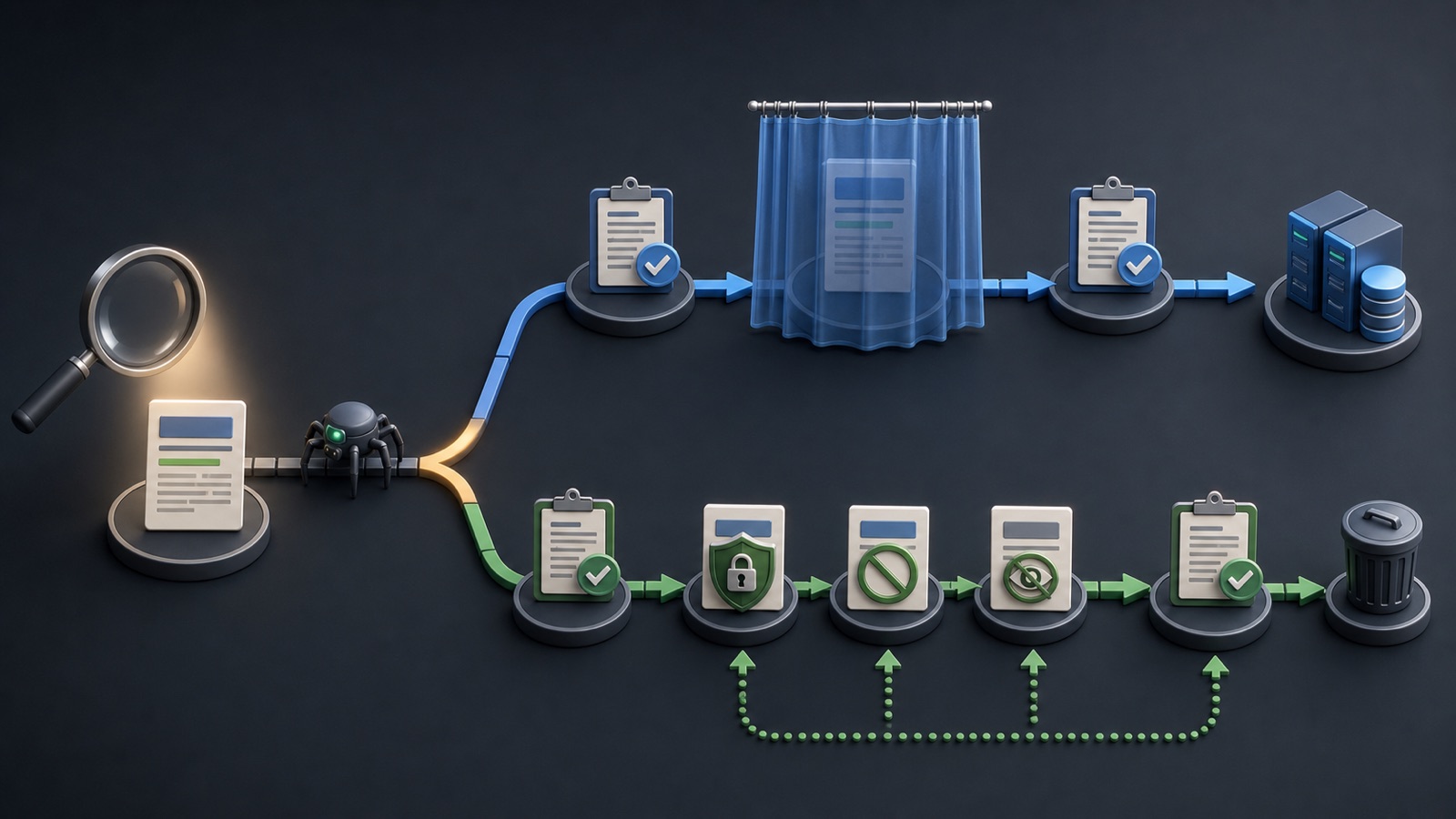
Google's Removals tool can temporarily block a URL from Google Search, but the effect is not a permanent deletion. Permanent removal generally requires the content to return a gone or not-found response, be access-controlled, or carry a noindex directive that Google can crawl. Robots blocking alone can prevent Google from seeing noindex.
VISUAL LESSON
What you will learn
- 01Choose temporary or permanent action.
- 02Implement a durable removal state.
- 03Verify processing without blocking the signal.
ILLUSTRATIVE WORKED EXAMPLE
Match illustrative situations to actions
PRACTICAL INTERFACE MAP
Move from incident response to durable state
Confirm ownership, canonical variants, query exposure, cached snippet, and whether access must stop immediately.
Submit the precise URL or prefix and record account, property, action, requester, and expiration planning.
Use 404/410, authentication, or crawlable noindex; remove discovery paths and monitor recrawl.
STEP-BY-STEP LESSON
Triage → temporary control → durable state → verify
THE LEAD ATLAS METHOD
Lead Atlas Data can produce a campaign-specific contact list by business category, market, and location while an organic team safely removes obsolete or sensitive URLs from search.See how custom list research works ↗Triage the exact risk
Confirm the URL, property ownership, canonical and parameter variants, whether the content is still publicly accessible, and whether the issue is stale text, sensitive information, obsolete content, or an unwanted entire section.
For exposed secrets or personal data, remove public access at the source immediately and follow the organization's incident process. Search removal is not a substitute for securing the content.
Use temporary removal for time-sensitive control
Submit the narrowest supported URL or prefix action in the correct Search Console property and record what the current interface says it will do. Temporary blocking provides a window to implement the durable fix.
Store requester, approver, action type, exact scope, date, reason, and review date. Avoid a broad prefix request when only one URL is in scope.
Choose the permanent state
Return 404 or 410 when the resource is gone, require authentication when it should not be public, or use noindex when the page should remain accessible but not appear in search. Keep redirects only when a genuine replacement exists.
Remove the URL from sitemaps and misleading internal links. Do not redirect unrelated deleted pages to the homepage merely to avoid a not-found response.
Let Google see the signal
A noindex directive must be crawlable for Google to process it. Blocking the URL in robots.txt first can prevent the crawler from seeing the directive, while the URL may remain known from links.
Test the final HTTP response, robots access, meta or header directive, canonical, authentication, and rendered content. Check variants including HTTP, HTTPS, host, path case, and parameters when relevant.
Verify over time
Monitor URL Inspection, server logs, site search, sitemaps, internal links, and Search Console reports. A removed result can reappear if the temporary action expires before the durable state is processed or if another URL exposes the same content.
Deliverable: risk record, exact URL inventory, temporary-removal evidence, permanent-state decision, implementation test, discovery cleanup, recrawl monitoring, owner, and closure criteria.
THE TAKEAWAY
Hide urgently when necessary, choose a durable page state, keep the URL crawlable long enough for noindex when used, and verify search and server evidence over time.OFFICIAL REFERENCES