YouTube's current native A/B testing can compare titles, thumbnails, or both for eligible videos. Unlike a click-only contest, YouTube says the winning option is based on watch time, which connects the packaging decision to whether the click led to viewing. The lesson is to test coherent promises, not visual tricks: each option should honestly describe the same video while making a distinct hypothesis about what the right viewer needs to understand.
VISUAL LESSON
What you will learn
- 01Write a packaging hypothesis.
- 02Build and launch an eligible native test.
- 03Interpret watch-time-based results responsibly.
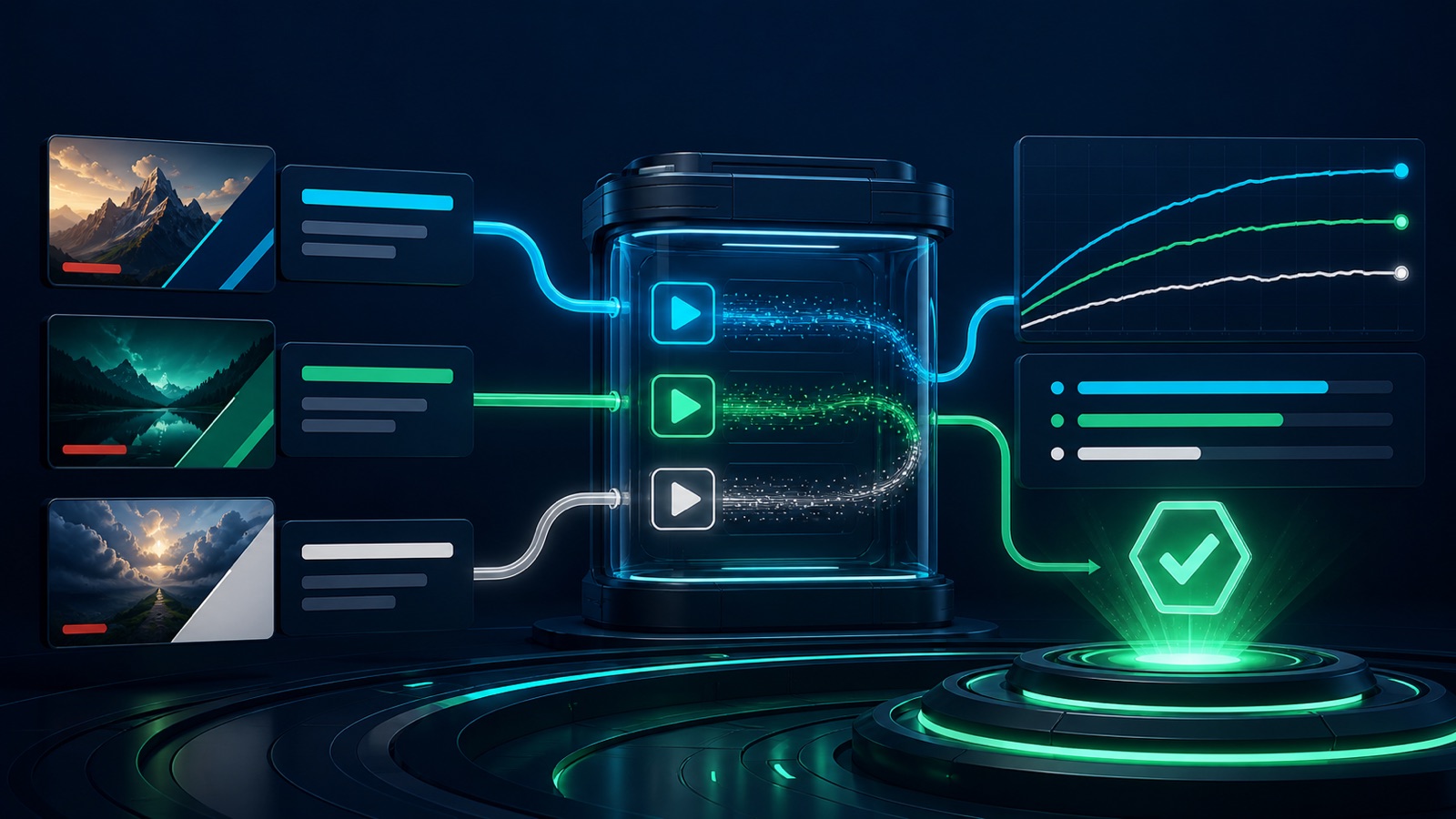
ILLUSTRATIVE WORKED EXAMPLE
Read an illustrative three-option test
PRACTICAL INTERFACE MAP
Set up a clean packaging experiment
Confirm feature access, eligibility, audience, traffic pattern, and that no major content or distribution change is planned.
Use YouTube Studio's current A/B testing flow to add titles, thumbnails, or both and launch the comparison.
Wait for the test state, document the winner or inconclusive result, and inspect retention and audience context.
STEP-BY-STEP LESSON
Packaging hypothesis → native test → watch-time evidence → reusable learning
THE LEAD ATLAS METHOD
Lead Atlas Data can build a done-for-you list of business contacts specific to the social campaign's categories, locations, and market, creating a direct distribution cohort separate from YouTube recommendation traffic.See how custom list research works ↗Choose the right test candidate
Select an eligible long-form video with enough ongoing impressions to learn, a stable topic, and a meaningful business or audience job. Avoid launching during a major promotion, external traffic spike, content edit, or other change likely to alter who sees the video.
Write the current baseline: title, thumbnail, impressions, click-through rate, average view duration, watch time, audience source, retention pattern, and desired viewer. Native testing can reduce manual rotation bias, but it cannot make a volatile video easy to interpret.
Write three honest hypotheses
Create options that emphasize different truthful frames: problem, result, comparison, specificity, or process. Each title and thumbnail pair must accurately represent the same video and set an expectation the opening delivers quickly.
Change enough to test a concept, not a tiny color preference. Avoid misleading faces, fake interface alerts, unsupported outcomes, hidden conditions, or thumbnails that attract an audience unlikely to value the actual content.
Build the native A/B test
In YouTube Studio, open the eligible video's details and locate the current A/B testing control. Choose whether to test titles, thumbnails, or both, upload the approved options, inspect crops and text on mobile and desktop, and start the experiment.
Record the launch time, options, hypothesis, owner, feature state, and any restrictions shown by YouTube. Do not repeatedly swap the video, description, promotion, or audience strategy during the observation window unless safety or accuracy requires it.
Interpret watch time and context
YouTube says its native test evaluates winners using watch time. Wait for the displayed result and preserve whether it is a winner, preferred option, or inconclusive state rather than forcing a conclusion from a small early difference.
Inspect impressions, click-through rate, average view duration, total watch time, retention around the opening promise, traffic source, returning versus new viewers, and downstream actions. A lower click rate can still support more valuable viewing when the packaging filters for fit.
Turn one test into a rule
Save the options and result in a packaging library. Write what the audience appeared to respond to, what remains uncertain, and which future video could test the same principle. Re-test when the topic, audience, season, or distribution context changes materially.
Deliverable: candidate baseline, audience job, three title-and-thumbnail hypotheses, accessibility and truthfulness review, native test capture, stable-test change log, final YouTube result, retention context, reusable packaging rule, and the next clearly different test.
THE TAKEAWAY
Test distinct but truthful packaging, protect the video and distribution from confounding edits, wait for the native result, and use watch-time evidence plus audience quality to guide the next version.OFFICIAL REFERENCES